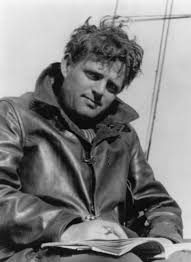
H.L. Mencken
Baltimore Evening Sun/January 20, 1911
The New York World’s Almanac for 1911, a large and comprehensive record of events, contains a list of all the men of eminence who died during 1910. The name of but on Baltimorean appears upon the list—that of Joe Gans, to wit. There may be folk who hold that Joe was not truly eminent but he was so in fact. Next to Toussaint L’Overture, Alexandre Dumas and Booker Washington he was the most widely known blackamoor of modern times. His fame expended to New Zealand, Alaska, the Philippines and the Cape of Good Hope. His portrait appeared in the public prints of Boston, Edinburgh, Melbourne, Manila, Ottawa and Pretoria. The news of his death was clicked into 10,000 newspaper offices and engendered emotions, more or less faint, in 150,000,000 breasts.
One might reasonably maintain, indeed, the thesis that Joe was the most notorious man, white or pigmented, that Baltimore ever housed. The fame of Edgar Allan Poe is plainly more secure, but Poe’s admirers—that is to say, his active and enthusiastic admirers—despite their wider dispersion, have probably ever equaled in number the throng that paid homage to Joe in his prime. If we would judge men by their public fame alone we must place him frankly at the head of all Baltimoreans, native or adopted. Who next? And next? A tentative list suggests itself:
- Joseph Gans, pugilist.
- Edgar Allan Poe, author.
- Jacob Kilrain, pugilist.
- Edwin Booth, actor.
- Joseph Jefferson, actor.
- Matthew Kilroy. baseball pitcher.
- William Osler, physician.
A “poor literary man,” writing to the New York Times, complains bitterly about the enormous amount of reading he must do to find out what the world is doing and saying, and in particular what other authors are doing and saying. He is in the habit, he says, of reading about 50 new novels a year, of say 400 pages each. Counting 400 words to the page (his own estimate, but a very liberal one), this works out to 8,000,000 words of bad fiction. In addition, he reads 25 standard books a year, 15 monthly magazines, three daily newspapers and a large number of miscellaneous disposses notices, rejection slips, street signs, street-car advertisements and theatre programs. Altogether, he says, he plows through about 67,000,000 words a year.
It would have been rather more interesting if he had attempted to estimate the area not of his reading, but of his writing. How much does the average journeyman writer, working eight hours a day, write in a year? The novelists, it is probable, do least. Very few of them write more than two novels a year, and the average novel contains no more than 75,000 words. Allowing for rewriting, this works out to 300,000 words a year, or about 1,000 a day. The average dramatist, doing two plays a year, seems to work less, for a play ordinarily contains but 20,000 words, but most plays, before they reach the stage, are rewritten, in whole or in part, fully 10 times, and so the dramatist, to get through his year’s work, has to labor like a stevedore.
But the champion authors are newspaper reporters. There are reporters, true enough, who probably average less than 1,000 words a day, but there are also others who often score 5,000 and sometimes even 7,000. Julian Ralph, reporting the second inauguration of Grover Cleveland, wrote more than 12,000 words in eight hours. I have myself averaged nearly 5,000 words a day for three or four weeks running, and other newspaper men have done the same. Five thousand words a day, six days a week, roll up to 1,500,000 words a year—the contents of 20 ordinary novels. No man, of course, could keep it up for a year. Even the elder Dumas seldom scored more than a million.
But a beggarly thousand words a day begins to be a burden after a few months. This column contains about 1,100 words. To fill it six days a week means to write 6,600 words a week, or about 28,000 a month, or 344,300 a year. A light and gentlemanly job! Most journalists write twice as much, and find time, in the intervals, to frequent the theaters, exercise their automobiles and move in society.
A muck0raker on the staff of the London Globe announces the discovery that the people of Munich are not beer-drinkers. Their per capita consumption during 1907, he says, was but 240 liters, or 254 quarts, or 62 gallons, or 8 ordinary barrels. In 1908, he says, it declined somewhat, and in 1900 and 1910 it declined still further. Eight quarter-barrels, true enough, seems a small annual ration for an able-bodied Municher, but let it be remembered here, before any tears are shed, that the per capital consumption is reckoned, not upon a basis of able-bodied men only, but upon the basis of the whole population.
In the United States it is commonly assumed that but one person in every five is a male of voting ae. In Bavaria, no doubt, the proportion is still smaller, for the Bavarians run to large families, and Munich swarms with children. But against that circumstance we may set the fact that the Munichers begin to drink beer somewhat before the age of 21, the further fact that the town harbors a childless garrison of 5,000 active military drinkers, and the still further fact that a number of Munich women, though not many, are also consumers of beer. Allowing for all these facts, it is probably safe to assume that about one Municher in every three may be regarded as a fair, average drinker.
This lifts the per capital consumption of beer, it quickly appears, from 240 liters a year to 720 liters—a difference worth noting, for 720 liters a year works out to two a day, or eight ordinary half-pint mugs. The standard mug of Munich, however, holds a full liter, which gives the Municher two a day. Is that all he drinks? The science of statistics seems to answer in the affirmative, but empiric observation puts his allowance nearer six.
 The Archive