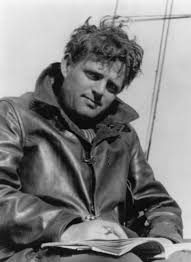
H.L. Mencken
Baltimore Evening Sun/June 14, 1916
§1.
Dr. Roosevelt’s sudden decision to retire from politics throws an extremely amusing light upon his patriotic ardor, and upon the standards of honor prevailing to our haut politique no less. A week before Armageddon the air was filled with his impassioned whoops and alarms, and the New York Sun (God save the mark!) hymned his altruistic frenzy to save the republic in endless dithyrambs. He was the Messiah foreordained; the self-sacrificing hero; the archetype of the brave and devil-defying gladiator. But the moment it became plain that the Job Incomparable was out of his reach, all his vast yearning to serve and suffer oozed out of him like sawdust out of a rag-doll, and as I write he sulks magnificently in his tent, announcing his retirement from politics and resigning the republic to the demnition bowwows.
A surprise? Not at all. Surely no one who knew anything about the San Juan Hindenburg took his bogus altruism seriously—no one, that is, save his faithful remnant of ragtag and bobtail followers. The amazing thing is that even these insatiable swallowers of buncombe were so easily deceived by his bosh. The fellow is really no more a patriot than such prehensile saints as Bryan, Schwab and Pierpont Morgan; patriotism is simply one of his devices for stirring up the boobs. When it fails, as it has just done, his fires go out in a twinkling. Within a week or so, in all probability, he will find retirement intolerable and break into the papers again. If he decides that Dr. Wilson is doomed, he will be hot for the fan-tailed Dr. Hughes; if he concludes that Hughes is a dead one, he will suffer a reconciliation with the late treasons and abominations of Dr. Wilson. If he can’t play the King, then let it be Warwick! Anything to keep before the plain people! Anything to pave the way for office!
§2.
I confess to much sneaking joy in this great master of balderdash; there is something frankly fascinating in the sheer fuming and fury of him, and as politicians go in These States he is anything but a poor specimen. If he had been nominated, I should have voted for him, as I did in 1912. He is too large and powerful a figure to go to waste. There is something almost sublime in his stupendous mountebankeries, and in the ease with which he gets away with them. To dismiss such a man as a common hypocrite would be as absurd as to dismiss Napoleon Bonaparte as a common murderer and blackleg, or John D. Rockefeller as a common shopman. He transcends all customary standards, both in the extent of his chicaneries and in the vigor and address with which he launches them. Such an homeric quack, as he himself believes and argues, should be constantly in high public office. He is at once the fairest fruit of mobocracy and its reductio ad absurdum. I nominate him for perpetual President, and guarantee that he will give a good show every day, with a double-header at least once a week.
His present defeat, I hope, is no more than temporary; he will come back with new issues, new alarms, new bugaboos, day after tomorrow. Dr. Wilson having neatly taken the wind out of the Perils of Invasion and the Crimes of the Germans, there remains yet another hobgoblin in the storehouse—to wit, the Crimes of the English. Soon or late it is bound to emerge on its own hook; the English, with characteristic stupidity, continue to war upon American commerce and the American mails without visible purpose or benefit; on some fair day, I daresay, the plain people will begin to see that we suffer damnably from the very tyrannies that Germany is fighting against, and that we ourselves fought against in 1812. The gods are on the side of the change; the popular mind is fickle; old bugaboos wear out, and new ones must be provided. I venture that Dr. Roosevelt will be in the ring when the band begins to play, particularly if it begins in time to shake up Dr. Wilson, There is plenty of evidence, indeed, that he would have started it himself, had he only beaten the judicial dahlia at Chicago. The whisper went ’round months ago that he was really pro-German; the hyphenates were privately assured that he would make England sweat as Dr. Wilson has made Germany sweat, and so grease their wounds; this was the true inspiration of most of the anti-Wilson resolutions passed during the spring, to the horror of the pro-English newspapers. I myself was categorically assured by one of his chief spokesmen that he hated England like the very devil, and would give a superb show if elected.
§3.
Meanwhile, the Crimes of Germany still had a certain life in them, and the “loyalist” newspapers were still hinting darkly at a German invasion (apparently after the English “crushing” of Germany), and so it was more profitable to play upon the resultant fear—more profitable, but not, alas, profitable enough to scare the delegates into line! The Belgian bugaboo, already dead and buried, was revived to give aid. Back in 1914 the good Colonel had seen nothing more in the invasion of Belgium than a regrettable act of war, but now he pumped it up with international law of the convenient Lansing brand, engauded it with the Bryce atrocities, and so tried to give it new life. This discovery that Belgium dad met with foul play was one of the most amusing developments of the ingenious Colonel’s campaign, for in order to prove the foul play he had to weep and tear his hair over the German violation of the treaty of 1830, and the more he wept and tore his hair, the more the judicious cast their minds upon his own gross violation of the Columbian-American treaty of 1846—a violation to which he had often pointed, in the past, as one of the most gallant acts of his Presidency. For the sake of the record I here print a strophe or two from that treaty, first reminding the intelligent reader that what is now the Republic of Colombia was then the Republic of New Granada, just as what was the Kingdom of Prussia in 1830 is now the German Empire:
For the security of the tranquil enjoyment of three advantages [of free transit across the isthmus], and in return for them . . . the United States positively and effectively guarantees to New Grenada, by the present stipulation, the entire neutrality of the isthmus. . . . and the United States guarantees in the same way the rights of sovereignty and ownership which New Grenada holds and possesses over the territory in question.
So much for our hero’s horror of the chief Crime of Germany. One recalls, somehow, his equally dubious horror of the Crimes of Harriman. . . . But I am not concerned about such dead fish. Suffice it to praise the brave Colonel for his versatility, and to lament that it used him so ill.
§4.
Just what part he will play in the coming clown show remains to be seen. The theory that he will actually remain hermetically sealed I reject as insane and against nature; before a month passes his bright eyes will be upon 1920, and he will be starting a Plattsburg camp for new bugaboos. If he comes out for Hughes, either immediately or later on, it will be a sure sign that he thinks the pallid jurist (now suddenly wreathed in smirks, and posing for photographers like Jess Willard) can beat Dr. Wilson; and in this notion, perhaps, there will be a considerable sagacity. If the Wilson campaign is to be waged, as is now announced, on the plea that the Doctor has at least kept us out of the war, it may be turned into a mocking at any moment by some unforeseen event on land or sea, or by the strategy of the opposition. Viewing the matter from a remote and austere detachment, it would seem to be far better tactics to get a war scare into training at once and loose it, say, two or three weeks before the election. This could be done (a) by sending England a furious ultimatum early in October, and arranging for Sir Edward Grey to return an equally furious answer two weeks later; or (b) by arranging with the same friendly gentleman to send a ship bearing Americans into some convenient mine field about the same time, first liberally salting the unhappy craft with fragments of a German torpedo.
I do not hint for an instant, of course, that such lamentable strategems of war could get the assent of any of the august parties to the combat, whether of one side or the other; but there are plenty of persons whose interest in the issue is almost as great as that of the actual candidates, and a number of them are happily devoid of prudery. The ultimatum I have mentioned might be very easily provoked by a vigorous newspaper campaign, directed, as the anti-German campaign was directed, from Wall Street. Such a campaign, by arousing the patriotic indignation of the plain people, would imperil the Administration ticket, and so force a compliance which would be justified anyhow by the plain facts. As for Sir Edward, he would undoubtedly see his way clear to meeting the desires of his American friends and agents, even to the extent of making a naughty answer two weeks before the election and withdrawing it a day after the election. The alternative plan should offer no difficulties whatever. There would seem to be innumerable Americans eager to brave the deep on English ships, despite the plain hazards of the business—and it is surely no offense to offer a patriot a way to die for his country.
§5.
On the other hand, the Hughes, Joffres and Mackensens will have similar opportunities for the exhibition of the higher sorts of strategy, particularly if the San Juan Von Kluck goes over to them. I have hinted at the possibilities inherent in the Crimes of England. Here in the big cities of the East, where almost all persons of any property and influence (including especially newspaper proprietors) are tarred with the munitions-business brush, and where, besides, Anglomania has long been a necessary ingredient of social pushing, it would be difficult to get the old hatred of England on its legs again; but in the interior of the country it is still alive, and a few ecstatic whoops against the Orders in Council would probably get the patriots to snorting. In parts of the South, indeed, they are already showing uneasiness in their cages. The people down there were amazed and disquieted by Dr. Lansing’s dutiful volte face on the armed ships question; most of their leaders in Congress, during the great debate of February 17-March 8, denounced England in phrases borrowed from the schoolbooks of yesteryear. So in the West, particularly in the Middle West, where an effective anti-English propaganda has been going on for some time. It would be easy to fan this spark into a flaming demand that something be done, and that demand, in the midst of a close campaign, would find Dr. Wilson in a very embarrassing position. If he assented to it, and actually pressed England for relief, he would lose the principal newspapers of the country, and with them the whole East; and if he stood pat on his friendliness to England he would lose the hinterland.
But here, no doubt, I set up a combat of ghosts. If the juridic Hughes, when he takes to the stump, makes an issue of the Crimes of England and so begins screaming for Strict Neutrality, an End of Persecution and the Protection of the National Honor, the salvation of the Administration ticket will be in the hands of Sir Edward Grey. All he will have to do will be to answer one of Dr. Wilson’s interminable notes, promising everything that the most violent Anglophobes demand, and the wind will be taken out of Dr. Hughes’ hirsute sails. And if, on the contrary, the late learned and upright judge pins his hopes to the Crimes of Germany, then Grey will be able to help the Administration by arranging a convenient atrocity somewhere on the high seas. The result will be a war scare, and a loud and convincing cry that horses had better not be swapped in crossing so wild a stream.
§6.
I write, of course, before anyone knows what the issues will really be. Just what Dr. Hughes stands for is still an impenetrable mystery, and I doubt that it will be cleared up when he speaks, for he seems to possess a truly judicial capacity for discoursing without saying anything. All I have heard certainly about him is that he is a Baptist, which is like saying that he prefers soft-boiled to hard-boiled eggs, for there are Baptists and Baptists, and the only point they have in common is that it is always possible to say of any one of them that, on at least one occasion, he has had a bath. In other matters they differ considerably, though most of them, I believe, lean toward the uplift. This, however, is nothing to get the teeth into: all Americans who are running for public office believe in the uplift, just as they believe in the Starry Banner, Abraham Lincoln, Dear Old Mother and the Gallant Boys in Blue. The only difference is that the non-Baptists tackle Vice, Privilege and the Rum Demon from the air, whereas the Baptists are submarines.
In the meantime (if Dr. Hughes is still a reader of the Evening Sun paper) I advise him to have no uneasiness about attacks on the ground that a judge should not run for office—that the bench should be kept beyond suspicion. Such gabble is for campaign purposes only. It issues chiefly from gentlemen who have done their best for years past to convince everyone that the bench is ignorant, corrupt and a disgrace to the nation. The argument will make no impression upon patriotic and intelligent Americans. It is the first and most sacred principle of the American code of honor that nothing is dishonorable while helps to get a man into the White House. I could cite examples, but refrain upon the advice of counsel.
 The Archive