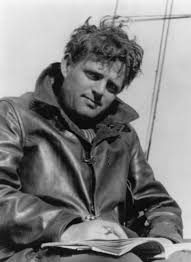
H.L. Mencken
Baltimore Evening Sun/February 2, 1911
Mr. Johnson The Forgotten
A man named Richard Mentor Johnson, it appears, was vice-president of the United States from 1837 to 1841. This Johnson was no ordinary, gilthead vice-president—no puny profiter by political accident; no shelves darling and prey of fortune. On the contrary, he had fought his way up from obscurity with such valor and persistence and was so powerful a politician and shrewd a man that even Andrew Jackson was glad to call him friend. Johnson was the Democratic boss of Kentucky, where the earthlings revered him as a superman; he had been a towering figure in Congress as representative and as senator, and in the War of 1812, serving as a volunteer colonel of infantry, he had slain the great Indian chief Tecumseh with his own hand. Altogether, he was a high and mighty magnifico of those times, and in 1844 he came very near breaking into the White House.
But Johnson is forgotten now—utterly and cruelly forgotten. His autograph sells for $1—the lowest price asked for any autograph that can be sold at all. It keeps company, in the dealers’ catalogues, with the autographs of fourth-rate poets, fifth-rate novelists, sixth-rate warriors and seventh-rate governors of eighth-rate states. Upon that cold roll the fame of every man is fixed. If the world still marvels upon him a scratch of his pen, however faded with age. is worth $10, $100, $1,000. But if he lives as a mere name, dimly and remotely heard, then his price is one lone dollar.
Knocked Down for a Dollar!
Johnson is not alone in the dollar class. In a catalogue now before me I find many with him—the Hon. E. D. Morgan, United States senator and governor of New York: the Hon. Lot M. Morrill, Secretary of the Treasury under Grant; the Hon. John Forsyth, Secretary Of State under Jackson and Van Buren; the Hon. Leonard Courtney, Speaker of the British House of Commons; Gen. John A. Dix, Secretary of the Treasury under Buchanan; the Hon. M. R. Waite, Chief Justice of the United States; the Hon. William M. Meredith, Secretary of the Treasury under Zachary Taylor. A long list of dead ones! The fatal dollar tells the tale.
Statesmen, it appears, are forgotten sooner than either poets or novelists, or at any rate, their fame is less wide and certain while it lasts. A fine autograph of John Quincy Adams, written while he was President, may be had for $17.50, but one of Charles Dickens costs $25, one of Edward Fitzgerald, translator of the Rubaiyat, $35; one of Bret Harte, $30, and one of Bobbie Burns, from $100 to $200. An autograph of Shakespeare would bring 20 times as much, in the open market, as one of Queen Elizabeth. One of Virgil, if it existed, would be worth a modest skyscraper.
But is it fair to judge the fame of men by the market prices of their autographs? Not always, of course. Fashion and chance enter into the matter. There is a great demand, at the moment, for Poe autographs, and their prices are soaring. Twenty years hence they may be depreciated 25 per cent. Again, the autographs of some men are valuable chiefly because they are rare. Several of the signers of the Declaration of Independence, for example, left few letters behind them, and so the collector who yearns for a complete set of signers must be prepared to pay heavily for the scarce ones.
The Influence of Fashion
But it must be apparent that mere rarity, in itself, cannot make an autograph valuable. Unless it is the writing of some man whose fame is reasonably secure, no one will care to buy it, no matter how rare it may be. As for momentary fashions in autographs, they affect the market but little. Now and then the letters of a given man are absurdly bulled, but more often what appears to be a passing fancy is really a belated understanding of some dead fellow’s importance. An autograph of Shakespeare, in 1660, would have brought no more than $2, but that was because Shakespeare had yet to reach full fame. Once his kingship was acknowledged his autographs became immensely valuable. It was not fashion that did the trick, but good sense.
At the Stedman sale, in New York the other day, a three-page letter from Edgar Allan Poe to Joseph M. Field brought $490. This high price was obtained partly because the letter was intrinsically interesting. It contained Poe’s reply to Hirman Fuller’s editorial attacks upon him in the New York Mirror. This letter to Field passed into the possession of his daughter, and on her death she left it to Lillian Whiting, her biographer. Miss Whiting, chancing to have a sitting with Mrs. Piper, the celebrated spiritualist, was advised by the spooks in that lady’s stable to give the letter to Edmund Clarence Stedman. Miss Field, she was informed, desired that it be done. Thus Stedman got the letter—and thus his heirs, later on, got $490. Them as has, gits.
Another Poe letter, referring to “The Murders in the Rue Morgue” and “The Maelstrom,” brought $375, and an elaborate refutation of Henry B. Hirst’s charges of plagiarism, in the poet’s own handwriting, brought $365. A daguerreotype portrait of Poe, much damaged, was knocked down for $250. The few known manuscripts of Poe’s tales are of enormous value. A wealthy collector in New Jersey owns most of them. If I remember rightly, he paid $5,000 for the manuscript of “The Raven.” Even a single signature of Poe is worth $100.
Walter Scotts Go A-Begging
Rudyard Kipling is still alive, but his autographs are already very valuable. Edward Lucas White, the Baltimore poet, who is a friend of Kipling’s, has a large number of long and interesting letters from him. Needless to say, they are not for sale, nor will they be for many years, for Mr. White is still young and vigorous and in receipt of a large income from his own poetry. At the Stedman sale a Kipling letter dated July 21, 1894, brought $45.
But alas for the Bulwer-Lyttons and Wilkie Collinses! A fine autograph of either man may be had for $2.25. A Marie Edgeworth is worth but $4, a Leigh Hunt but $5.50, a “Hans Breitman” but $4.50, a Richard Le Gallienne but $1. Worse still, a Walter Scott sold in Now York the other day for $7.50—just $3 less than the price brought by a James Whitcomb Riley!
 The Archive