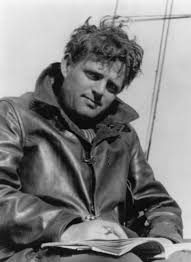
H.L. Mencken
Baltimore Evening Sun/May 17, 1916
Some pseudonymous psychologist, attempting the other day in this place to defend me against the snorts of critics whom I do not know and never read, smeared me with such carboys of lard toward the end that a good deal of it slopped over upon the Evening Sunpaper. Why it should be regarded as “big” and a source of “unholy joy” for a newspaper to print such harmless and obvious stuff as I compose for these columns is quite beyond me. I have been writing for the public press for 18 consecutive years, and I surely know enough by this time to avoid debauching it with anything even remotely approaching actual ideas. Such poisons, when the kind gods occasionally put them into my hands, I reserve for the books that I propose to publish after I am 40—books that already take on a considerable bulkiness, and, in spots begin to show merit. To spread them in the columns of a provincial newspaper, between Peruna advertisements and editorials hymning Woodrow as a second Lincoln, would involve not only a sheer waste of them, but also a confession of a lack of self-respect which, to me at least, would be quite impossible. To seek a parallel for such a gross abandonment of civilized decency, so vulgar a spitting upon all that is dignified and seemly, one must turn to the man who subscribes to charity funds collected by newspapers, and so has his name and subscription advertised, or to the disgusting cad who gauds himself with a silly flower on Mothers’ Day to assure car conductors, corner loafers and street-walkers that he loves and respects his mother.
Nay; I do not violate my pruderies, nor the Evening Sunpaper’s, by any such forgetting of the proprieties. All I ever write for these intolerably wide and vacant spaces is what any other average man, free from the superstitions of democracy, would write if he had the time, and could spell and punctuate as facilely as I can, and knew as many strange and portentous-looking (but usually meaningless) words. In brief, I compose articles by arranging in artistic form the platitudes of the minority, just as my learned brother, the editor of the Sunpaper, composes editorials by arranging in artistic form the platitudes of the majority. Why it should be regarded as courageous to print the former passes my comprehension. Is it actually dangerous? Does any punishment follow? Does it involve any loss of money—or even of honor, a much less valuable commodity? If so, I am quite unaware of it. On the contrary, it seems to me to be both safe and profitable, and I am surprised that it is not done more extensively. Why not a whole department for the civilized, just as there are departments of society, of sport and of fraternal orders? Or even a whole page? Why not, indeed, hand over the whole paper to them once or twice a year, as papers are sometimes handed over to the suffragettes, and so soothe them in their exile? I offer the suggestion and pass on. But I refuse to see anything “big” in what is essentially as harmless as kissing a cow.
§2.
Despite, however, this descent to a banal sentimentality, the defender I have mentioned confected a creditable article, and in the midst of all the deafening explosion of vaseline rockets and speckgranaten he managed o draw an accurate distinction between the two grand divisions of word-mongers and paper-spoilers—i. e., those who seek to make converts and those who pursue the truth for its own sake. More, he showed clearly that this distinction is quite incomprehensible to the former—that they can never understand their opponents. But he stopped before he showed why that should be so. The reason may be briefly stated. It lies in the fact that the proselyting type of man is simply one who confuses what is merely erroneous with what is downright criminal. His central belief is always that the other fellow is not only wrong, but also a scoundrel. Cherishing this belief, it is natural, of course, that he should be eager to bring the other fellow up to grace, for scoundrelism is dangerous and disagreeable, and it has been the aim of all public-spirited men, at all times and everywhere, to put it down whenever possible. This desire to do so, this frenzy to make converts among the abandoned, is, in its higher manifestations, almost wholly altruistic. I found it so in Dr. Sunday, as I said at the time. He sweated to convert his flat-heads to his Ethiopian voodooism, not because he hated them, but precisely because he feared for them and wanted to help them.
Take away the notion that the other fellow will be damned for his error, and you will take away all incentive to convert him. This explains why those of us who believe that he will not be damned are so indifferent to the effect of our artillery upon him. If he is converted, well and good; if he is not converted, well and good again. I myself, when I expose pseudo-ideas in this place, have absolutely no desire that anyone should embrace them and begin whooping them. My objects are quite different, and may be stated thus: (a) to pick up a few easy dollars without appreciable effort, (b) to afford a mild amusement to the civilized, who already agree with my platitudes, by putting those platitudes into graceful and charming forms—i. e., by turning the obvious into the æsthetic. As for the effect upon the uncivilized, I never give it a thought. If what I write displeases them, I am not interested, for nothing that they think is of any interest to me. And if it pleases them, I am equally unmoved, and for the same reason. Life is too short for anyone to be bothering about the ideas of those whose distinguishing mark is that they have no ideas at all. I hand them over, like old Friedrich, to statistics and the devil.
§3.
Such an attitude of mind, of course, is incomprehensible to the stupid—i. e., the moral—and so they explain it by crediting it to moral turpitude. This process is very familiar, and I myself have been the amused butt of it on innumerable occasions. Every time I have ridiculed some fresh batch of numskull uplifters for demanding that everyone become straightway converted to their bosh, they have accused me, not only of error, but of scoundrelism. In this Puritan Commonwealth, indeed, the step is almost universally made. The making of it becomes the hallmark of the Anglo-Saxon, and is the best of all proofs of his spiritual degeneration. Long years of mob rule have made him think exactly like the mob. He cannot imagine a respectable opponent, his peer in virtue. Everyone who differs from him or opposes him is not only wrong, but a scoundrel, and his dialectics consist almost entirely of that accusation. All his thinking thus takes on an ecstatic, crusading tinge, incomparably ludicrous to the more effective and intelligent spectator. He even injects concepts of morality into his party politics—i. e., into the question as to whether this patriot or that one shall get a given job. In every political campaign in the United States since Jackson’s time each side has accused the other of an unspeakable moral delinquency. We hear nothing but gabble about crowns of thorns, Armageddons, hyphenates, money devils, corruption funds, traitors, betrayals, German spies, crimes of ’73, Wall Street—an endless string of bugaboos and hobgoblins, all quite real to the stoneheads.
The discussion of the issues arising out of the present war has offered a prodigious mass of clinical evidence of this moral bemusement. The theory that those who believe Germany to be in the right are in error has long since given place to the characteristically Anglo-Saxon theory that they are scoundrels. You will find this theory in every newspaper editorial upon the subject for a year past and every utterance by the President of the United States. It is actually held against such persons as their chief crime that they presume to present their views to the proper authorities. And the orthodox discussion of the opponents of American “neutrality” across the water is full of the same sweet stuff. The Germans are not only in error in thinking that their country is right; they are scoundrels for fighting for it at all. So with the Irish. Their effort to get some benefit out of England’s gallant and altruistic struggle for the freedom of “the smaller nations” was not only ill-advised; it was an act of infamy, a moral atrocity.
§4.
But I avoid a war discussion, however academic. The lights that the turmoils of the past couple of years have thrown upon the processes of the Puritan mind will appear at length in my projected work, “The Anglo-Saxon Under the Terror,” of which Band I is already on paper, and safely beyond the reach of the pious. All I need say here—and the saying really should be supererogatory—is that no moral judgments will corrupt this friedensfestschrift; that it will not denounce the Anglo-Saxon for having weaknesses, and for yielding to them in a trying time. To quote old Fritz again, moral judgments are foreign to my nature. I do not see that morality has anything tgo do with the fact that one man is black and another white, that one thinks this way and another that way, that one reacts to danger in a certain manner and another in some other manner. They differ in these ways because God hath made them so, and I do not venture to criticize God.
Here, of course, I fall out of step with the national Puritanism, and my unpatriotism—i.e., scoundrelism—becomes plain to the very blind. The Puritan simply cannot imagine such a point of view; to affect it is, in his sight, as extravagant and outrageous as to affect a liking for cannibalism. Regarding all his opponents as scoundrels, he assumes glibly that they regard him in the same way, and that they are thus trying to rescue him from his beliefs and convert him to their own. Hence his vast intolerance of heterodoxy, his invariable demand that the heretic be put down by law, his pathetic faith in the efficacy of the police against ideas. In my old days on the Evening Sunpaper, when it was part of my job to read the Forum regularly, and to go through, besides, all prohibition and suffragette papers, Methodist weeklies and other such gazettes published in Baltimore, I was struck constantly by the extent of this belief in repression. I think I may say honestly that, from beginning to end, no Puritan opponent ever wrote three paragraphs against me without voicing the demand that I be silenced. Those demands I cherished with ironic gusto; the war has enormously reinforced them; I shall bring them into use in another volume of my forthcoming studies of the brave Anglo-Saxon.
§5
As I said in mentioning Dr. Sunday, the Puritan’s yearning to save the other fellow from his scoundrelism is, in its higher manifestations, largely altruistic. But these higher manifestations are not often encountered. Usually the Puritan transforms his detestation of the theoretical crime into hatred of the theoretical criminal, and the result is much ill feeling, and sometimes a conflict that leaves scars. I have no aspiration toward sanctity, and confess freely to many petty and abominable meannesses, but I should dislike to cherish such evil thoughts of any fellow-man, however much he displeased me, as those revealed so often by some of the consecrated donkeys of the Ministerial Perunion. If the compound of spite and impudence that these rev. gentlemen of God display is the Only True Christianity—if these fair heretic-hunters, eye-rollers and Menace-readers are really ambassadors of Christ, and of the apostolic succession—then it is my firm opinion, as a neutral, that the break-up of Christianity would be a good thing for the world. And if it be true, as patriots now argue, that any man who ventures to stand against the prevailing ideas in politics makes a forfeit thereby of his very right to stand at all, then the best thing we can do is to tear down the republic and build it all over again. We come, it seems to me, to a time of decision. We must either formally adopt reasoning by orgy and go down in turmoil, or go back to that fairness and toleration and charity which were the web and woof of the liberty dreamed of by the fathers.
§6.
But the older I get the less such reforms interest me. Let them come or not come; I am surely not going to get into a sweat about it. My delusions are silly, but not messianic. I say my say, and then shut up. If I violate your pruderies, by all means set up a yell and get your hot protest upon paper; I shall not read it, and so it will not bother me. And if, weakened by alcohol and the sorrows of the world, you allow me to convert you to this or that, then please keep it to yourself. Don’t come around blubbering that I radiate the True Light. I know it already. Besides, I doubt it. . . . An occasional salvo of cold cream from a fellow lost one—well and good. I, too, can grease; the sport costs little, and is grateful to the gill. But the pawing of disciples, whoopers, converts! . . .
 The Archive