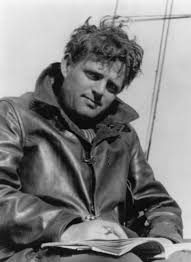
H.L. Mencken
Baltimore Evening Sun/March 14, 1916
§1.
A connoisseur for many years of rabble-rousing in all its forms, and a lifelong student of the sacred sciences, I can see nothing either very novel or very scandalous in Dr. Sunday’s pulpit cavortings, and surely nothing to amaze and bruise the higher cerebral centres in his theology. As for the first, he merely does with extraordinary agility and gusto what many another sweating gentleman of God has done before him, and as for the second, he merely serves up anew that old mess of charming theories and violent affirmations which the Puritan divines have been discharging at a sinful world for two centuries. In other words, he is not something new under the sun, but simply something old in a fresh bib and tucker. The difference between him and any other Puritan whooper is not a difference in message, nor even in method, but merely a difference in skill. He knows his business better than the others, and so he gives a better show, and attracts a bigger crowd.
Personally, I dissent in many ways from the scheme of post-mortem salvation that he advocates, and have, in fact, no very active desire to be saved at all, but all the same I heard him the other night with immense interest, and sat in unfeigned admiration of his ingenuity, his vivacity, his bold address, and came away after two hours with a pleasant feeling that I had encountered something very rare in so stupid an old town as Baltimore, to wit, a sharply differentiated personality, a man of force and resourcefulness, an unusual and agreeable fellow. I should like to spend an evening at the biertisch with the learned doctor, and hear his private views of some of the Only True Christians that he has to deal with in the cities he saves. He would be, I venture, a good one to cross the ocean with, or to go fishing with. . . .
§2.
Sincere? Undoubtedly. Crazy? By no means. To question the sincerity or sanity of such a mob-master is too facile and illusory a way of disposing of him. I haven’t the slightest doubt, of course, that Sunday, like any other fellow who appeals to the emotions, has mixed up a good deal of sophistication with his frenzy, that he is self-conscious and a bit cunning, that he knows certain sure-fire tricks which draw a good deal more blood than simple earnestness, and that he is not above using them on occasion. To say all this is merely to say what is obvious. No man can make any noticeable impression upon the great masses of men, no matter how much he is filled with his message, unless there be some flavor of the mountebank in him, for the great masses of men can think and feel only in ways that they have thought and felt in before, and the mountebanks of forty centuries have worn deep grooves in their heads and hearts. But at the bottom of all of Sunday’s wildest extravagances of manner there is still visible a very genuine belief in the utility and importance of his work, and underneath the superficial novelty of his theology there are ideas that have been afloat in the world for years and years, and that the vast majority of Americans, not to mention the men of other nations, have long subscribed to.
The first, foremost and most immovable of these ideas is simple and charming. It is this: that the other fellow is not only wrong, but a scoundrel. Here we have the central doctrine of the Puritan theology, and not only of the Puritan theology but also of all other theology down to a few years ago, and not only of all theology but also of most other human thinking, particularly on the political side. Dr. Sunday merely states the principle with unusual clarity. The late Charles Darwin rejected the immutable doctrines of Calvinism—e. g., predestination. Ergo, Darwin was not only in error, but willfully in error, and hence a rogue, a low-life, a ganov, a schuft, a knave, a villain, a felon, a child-stealer, a hell-hound, a dirty fellow, a ———, a ——— ——— ———, a ——— ——— ————. He is in hell and will remain there forevermore, and all who follow him in his heresy, or even give serious consideration to it, will infallibly roast with him.
§3.
Baldly stated, a somewhat pifflish doctrine, and yet surely no novelty in the world. What else is preached, indeed, by such eminent soothsayers as Colonel Roosevelt and Dr. Wilson? Search the bulls and encyclicals of the latter from end to end, and one will never find the slightest hint of an admission that the other fellow, for all his apparent error, may be actually right, and that, in any case, his fidelity to his views deserves respect. No; the contention is always exactly to the contrary: the other fellow is not only definitely and irremediably wrong, but there lies in his wrongness the proof of moral turpitude; he is, in brief, a flouter of divine revelation, and it is the duty of every right-thinking man to rout him, punish him, and put him down by force. So with the consecrated Colonel. He does not argue with his opponents; he does not seek to persuade them; he merely denounces them as scoundrels, and sings a hymn in testimony of his own eternal rightness and righteousness.
All Puritanism is shot through with this naif notion, this irresistible tendency to make of every evidential matter a purely moral matter, and not only Puritanism, but also all other fashions of thinking which men embrace in the mass. I need not point out that the Catholic Church also dallied with this madness in its day; the pages of history are full of the story. And that day extended down into our own time, as everyone knows who remembers the sensation that Cardinal Gibbons made in Rome when, preaching in his church of Santa Maria in Trestevere, he voiced his revolutionary and historic plea for “our separated brethren in America.” The old church seems to have seen the light; whether through impotence or through a growth in reasonableness, it no longer seeks to save the heretic by terror. But Puritanism, being still both strong and stupid, continues in the old, old way, here, there and everywhere, and so it cannot be justly maintained that Dr. Sunday’s fulminations are unusual, or that the theories of salvation and damnation that he sets forth are singular to his own theology.
§4. As for his extraordinary success in drawing crowds and in performing the hollow magic commonly called conversion, it should be easily explicable to anyone who has seen him in action. His impressiveness, to the vegetal mind, lies in two things, the first being the sheer clatter and ferocity of his style, and the second being his utter lack of those transparent pretensions to intellectual superiority and other worldliness which mark the average evangelical divine. In other words, he does not preach down at his flock from the heights of an assumed moral superiority—i. e., inexperience of the common sorrows and temptations of the world—but discharges his message as man to man, reaching easily for buttonholes, jogging in the ribs, slapping on the back. The difference here noted is abysmal. Whatever the average
osseocaput’s respect for the cloth, he cannot rid himself of the feeling that the holy man in the pulpit is, in many important respects, a man unlike himself, and hence one but faintly familiar with the difficulties of life as he has to live it, and a somewhat feeble theoretician in his ideas about ways and means of meeting and overcoming those difficulties. The white choker, to this stonehead, marks off a separate caste, almost a separate species. The cleric is one who is protected, by his very office, from the grosser deviltries of the world: his aura is a sort of psychic monastery; his advice is not that of a practical man, with the scars of combat on him, but that of a dreamer wrapped in aseptic cotton. Not so Dr. Sunday. Even setting aside his painstaking avoidance of anything suggesting clerical garb and his indulgence in obviously unclerical gyration on his sacred stump, he comes down so palpably to the level of his audience, both in the matter and the manner of his discourse, that he quickly disarms the old suspicion of the holy clerk and gets the discussion going on the familiar and easy terms of a debate in a barroom. The raciness of his slang is not the whole story by any means; his attitude of mind lies behind it, and is more important. That attitude of mind is precisely the attitude of mind of the people he is trying to reach. It is marked, above all, by a contemptuous disregard of the theoretical and mystifying; an angry casting aside of what may be called the ecclesiastical mask, an eagerness to reduce all the abstrusities of Christian theology to a few simple and (to the ingenuous) self-evident propositions, a violent determination to make of religion a practical, an imminent, an everyday concern. And he accomplishes this business (so often attempted, and with such sorry lack of success, by other preachers) simply and solely because his experience of the world, in point of fact, is that of the average man, because he sees things from the pew instead of from the pulpit, because he is not, in truth, a preacher at all, but merely a convert preaching.
§5.
I heard him, the other night, tell a story about a gambling house, the details of which I forget. But the secret of its effectiveness still remains plain: he talked of that gambling house, not in the way of a preacher who had read about it in a newspaper, but in the way of one who had visited it, and played in it, and knew all about it. He mentioned quite
casually the state of the game when he entered; he told exactly what was going on; he even described with plain zest how some patron or other had won $140. A chuckle of recognition passed over the audience. Here was no theorist, but a man who understood faro, and not only its technique, but also its fascination. One could see with half an eye that he clearly recognized the temptation of the fellow he was trying to rescue and sympathized with him unaffectedly. And the denunciation which followed was not the denunciation of one safe and secure—of a man intrenched behind a white tie and a long-tailed coat—but of one who had been himself exposed to the fire, and perhaps scorched a bit, and maybe even burned severely. It was, in brief, not an appeal from preacher to man, but one from man to man, and two-thirds of the power of it lay in the recognition of likeness which it evoked.
The value of this recognition of likeness, of course, is not unknown to the clergy. One hears constantly of dashing young dominies seeking a better experience of the world they revile by snooping in the summer parks, courting strikers and Socialists, setting up secular amusements, touring the bawdy houses, going into politics. But that sort of transformation is seldom really feasible; once a preacher in a white choker, a professed separatist, always a bit of a stranger in the crowd. It is the advantage of Dr. Sunday that he has never become an actual clergyman, that he is still nine-tenths baseball player. The crowd, with the best intentions in the world, always sees the clergyman through a fog. But it can understand and appreciate a baseball player. . . .
§6.
The converts snared by the incomparable doctor’s windjamming on the night I heard him were anthropoid, but little more. In all my life I have never looked into more stupid and miserable faces. At least a half of the candidates for harps were adolescent and chlorotic girls, and plainly in greater need of Dr. Howard A. Kelly than of Dr. Sunday. Even an osteopath would have noted a deficiency in hæmoglobin, a disturbance of digestion and a profound veneration for moving-picture actors. Some of them seemed to be flirting with tuberculosis; many of them had heads of curious shape and eyes that did not match; nearly all looked pitifully poor and wretched and godforsaken. Of such, perhaps, are the kingdom of Heaven. Let us hope at all events that, somewhere or other, they will get square meals, and less work, and a chance to learn what joy is.
The elders, so far as their faces showed anything, were unanimously numskulls—silly, frowsy-looking middle-aged women, young men without chins, older fellows of the obscene, furtive sort one encounters in water-front missions and such like garbage piles. In brief, the defective, the empty, what Nietzsche called the botched. I suspect that a keg of free beer would have sent most of these embryo angels sneaking out of the Tabernacle. I do not except the ladies. More than one of them bore the label of the saufschwester, the horrible blue tint of katzenjammer. . . .
§7.
But that was last week, in the first days of trail hitting, and no doubt the worst come first. I am putting off my second visit until Dr. Sunday begins to bag game of greater weight upon the hoof. The police, my agents tell me, have begun to leap into the cleansing pool, some of them in full regimentals. Perhaps the firemen, the street car conductors, the garbage men and the City Councilmen will follow next. But I shall wait until the Honorary Pallbearers get het up. It will be happiness indeed to see these veterans of the bubble-water and casket-handle go through the mill. They are hardened sinners; it will take all of Dr. Sunday’s eloquence to shake them. And once they have cast off their wickedness, Baltimore will be pure at last. . . .
 The Archive