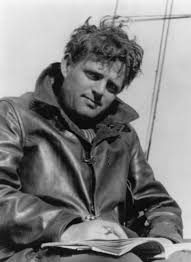
Ambrose Bierce
Cosmopolitan/September, 1907
“THE Autobiography of an Automobile” is the fruit of a mature opportunity long awaited. Now let us have “The Confessions of a Truck” and “The Love-Affairs of a Road-Roller.” And let the President abstain from contumelious disparagement of vehicle-fakers. What can a horse-rider really know about the sentiments and emotions of a wagon?
The author of “As Ye Have Sown” proves the vices of the British aristocracy by the convincing method of making all the aristocratic characters of the novel vicious. That may be called the demonstration feasible.
Mr. Joaquin Miller unveils his ambition to be a United States senator from Oregon, where he was once Registrar of Earmarks for Swine. Mr. Miller has a bright political prospect behind him.
An enthusiastic poet sees already “the Parliament of Man.” Move we adjourn.
Not a single great novelist has risen since, two months ago, one of the “six best sellers” contained this discouraging passage:
“Profoundly affected, Leona retired to the conservatory and uttered a deep-drawn sigh, then, returning to the ballroom, flung herself into the waltz with an assumed ecstasy that elicited wide comment.”
A writer in “The Academy” calls the modern novel a “vampire.” Dear, dear; what a hard name for something that hasn’t a tooth in its head!
From “The After Life,” by Mr. Henry Buckle, one may get an instructive general knowledge of what all the peoples of the world have believed about immortality. But one will learn nothing about immortality.
It must be pretty generally understood now that all the “Americanisms” for which our English cousins ridicule us have the authority of the usage of the best English authors, dead and living. In a thousand books and magazines our own writers have shown that to be so by copious quotation; yet Senator Lodge thinks it worthwhile to reaffirm it and hammer it home into the indurated understandings of our critics beyond the water. The good work is now half done; they are convinced; it only remains to silence them. If Mr. Lodge can do that he will not have lived in vain. But in any case he ought to be a better grammarian than to say, “Sir Leslie Stephen, than whom there was no more careful writer.” If for this use of “whom” Mr. Lodge plead a nearly universal usage one will have to confess that it is indeed open to that additional objection.
If the red slanger think he slangs,
Or the slang that it is slung,
They little know the ancient gang
Of scholars who that song have sung.
Wherefore, when the uptodaters and geewhizzers chortle in their glee for having “called down” somebody or something they reckon ill in leaving out the illustrious author of “The Advancement of Learning.” That volume of fairly good English says (2. 1. 3.), “If an untruth of nature be once on foot, what by reason of the use of the opinion in similitudes and ornaments of speech, it is never called down.” When Mr. George Ade and Mr. W. J. Lampton leave this vale of tears (may it be weeks hence) and enter Elysium perhaps they will not disdain to proffer the hand of fellowship to the shade of Francis Bacon.
Jack London’s navigator and crew deserted at the first port where they got shore leave. It was easy to ship a new crew, but he will look a long time before finding another navigator who knows that the earth is hollow and we live inside the shell.
We may perhaps be permitted to doubt the publishers’ advertisement of a book called “Brown of Harvard” when it says that a “striking dénouement seizes the reader’s attention at the start and holds it to the end.”
If that Oxford degree is going to compel us to call him Doctor Clemens I’m for handing it back. We are all willing, I suppose, to face the exigencies of the situation in a spirit of concession and call him Doctor Twain, if that is acceptable to the fair, large ear of British propriety; or, if King Ed’ard will knight him we will compromise on Sir Mark and throw in the Monroe Doctrine to show our good will; but some part of that honored pseudonym we shall keep while we have a soldier or a ship. It designates one who has suffused our country with a peculiar glory by never trying to write a line of poetry.
We are told by an eminent observer that no fishmonger cries, “Stinking fish!” but Mr. William Farquhar comes within a measurable distance of that unattained candor by declaring that all his future stories are to be “psychological problems.”
Honest man!—he never traps
Any heedless reader-chaps.
He will warn them ere he rob them
With a psychologic problem.
A distinguished Richmond editor with as much of the blood of Pocahontas in him as any man of his years is steadfast in the faith that Thomas Nelson Page’s poem read on “Virginia Day” at the Jamestown exposition, “will live as one of the greatest, if not the greatest, of Virginia’s poetical classics.”
As a poet, Deacon Page is one of Virginia’s most respectable citizens.
“For summer reading,” a literary contemporary mentions and describes “one hundred good books,” all published in the first half of this year. That is more good books than have been published in my time, and I am no child: I have outlived several thousand of “immortal” works, mostly novels. It looks as if some envious malefactor were diligently unwriting all such.
One of its protagonists sees in slang “a sign of progress.” Then the march of mind is a lock-step. The interesting situation is that progress has advanced an inch and this fellow an opinion.
Joel Chandler Harris is of the conviction that “the note of provinciality is one of the chief charms in English literature.” Possibly that explains the primacy in charm (to the metropolitan understanding) of the literature made in New York; for provinciality is there the dominant note. No place is so truly provincial as that admirable and admiring city: it neither knows nor cares about anything written elsewhere in America. And nearly all that is good in its own product is made by writers from afar. If all but two or three of its native writers, ceasing to write, would till the soil, literature would profit at the expense of agriculture.
We are promised by a New York publishing house an autobiography of Victor Hugo. The name of the author is not disclosed.
A London writer points out in the British public “a changed attitude toward George Bernard Shaw.” True: the B. P., which has been dodging, is now ducking.
“Beethoven’s sonatas for the piano,” saith a writer in “The Nation,” “are better than Schubert’s, not so much for structure as because there are more good ideas in them.” There are no ideas in music. It has no intellectual character, but is purely emotional. Music is good in the degree to which it forbids thought and compels feeling. An idea is expressible in words, and words may be “set to music,” but the words are no part of the music. Fancy Beethoven as a thinker!
 The Archive