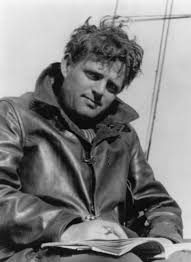
Richard Harding Davis
San Francisco Examiner/December 26, 1915
Watches French Fighters Firing on Germans Stone’s Throw Away
Magic Slip of Blue Paper Admits Writer Behind Scenes of Battle
IN Artois we were “personally conducted.” There were two charming French officers who acted as our hosts, guides and guardians, four American newspaper men, a Dutch journalist and a Spanish poet. In a way we were the guests of the War Department; in any case, we tried to behave as such. It was no more proper for us to see what we were not invited to see than to bring our own wine to another man’s dinner. What we saw increased our admiration for the marvelous efficiency and organization of the French army, but we did not get very near the first trench. For purposes of description, not a bit further than when we were in New York.
The official explanation was that there were too many of us, that we offered a target to the enemy. We valiantly protested we were paid to be targets, but our polite hosts would not permit us to earn our wages. In Champagne it was entirely different. I was alone with a car and a chauffeur, and a blue slip of paper. It permitted me to remain in a certain place inside the war zone for ten days. I did not believe it was true. I recalled other trips over the same roads a year before which finally led to the Cherche-Midi prison, and each time I showed the blue slip to the gendarmes I shivered.
But the gendarmes seemed satisfied, and as they permitted us to pass further and further into the forbidden land the chauffeur began to treat me almost as an equal. And, with as little incident as one taxis from Madison Square to Central Park, we motored from Paris into the sound of the guns.
Like Favor from Fairy
At the “certain place” the general was absent in the trenches, but the chief of staff asked what I most wanted to see. It was as though the fairy godmother had given you one wish. I chose Rheims, and to spend the night there. The chief of staff waved a wand in the shape of a second piece of paper, and we were in Rheims. To a colonel we presented two slips of paper, and, in turn, he asked what was wanted. A year before I had seen the cathedral when it was being bombarded, when it still was burning. I asked if I might revisit it.
“And after that?” said the colonel.
It was much too good to be real.
I would wake and find myself again in Cherche-Midi prison.
Outside the sounds of the guns were now very close. They seemed to be just around the corner, on the roof of the next house. “Of course, what I really want is to visit the first trench.”
Like Quizzing Mason
It was like asking a Mason to reveal the mysteries of his order, a priest to tell the secrets of the confessional. The colonel commanded the presence of Lieutenant Blank.
With alarm I awaited his coming. Did a military prison yawn, and was he to act as my escort? I had been too bold. I should have asked to see only the third trench. At the order the colonel gave, Lieutenant Blank expressed surprise. But, with a shrug as though ridding himself of all responsibility, his superior officer showed the blue slip.
It was a pantomime, with which by repetition we became familiar. In turn each officer would express surprise; the other officer would shrug, point to the blue slip, and we would pass forward. The cathedral did not long detain us. Outside, for protection, it was boarded up, packed tightly in sandbags; inside it had been swept of broken glass, and the paintings, tapestries and the carved images on the altars had been removed. A professional sacristan spoke a set speech, telling me of things I had seen with my own eyes, of burning rafters that spared the Gobelin tapestries, of the priceless glass trampled underfoot, of the dead and wounded Germans lying in the straw that had given the floor of the cathedral the look of a barn.
Now it is as empty of decoration as the Pennsylvania Railroad station in New York. It is a beautiful shell waiting for the day to come when the candles will be relit, the incense toss before the altar, the gray walls glow again with the colors of tapestries and paintings. The windows only will not bloom as before. The glass the Emperor’s shells destroyed, all the king’s horses and all the king’s men cannot restore.
Gives Morbid Details
The professional guide, who is already so professional that he is exchanging German cart ridges for tips, supplied a morbid detail of impossible bad taste. Among the German wounded there was a major (I remember describing him a year ago as looking like a college professor) who, when the fire came, was one of those the priest could not save, and who was burned alive.
Marks in the gray surface of a pillar against which he reclined, and grease spots on the stones of the floor are supposed to be evidences of his end, a torture brought upon him by the shells of his own people. Mr. Kipling has written that there are many who “hope and pray these signs will be respected by our children’s children.” In warfare there is nothing so savagely implacable as the middle-class civilian Englishman who advocates “reprisals,” and brass bands to encourage other Englishmen to recruit. Mr. Kipling’s hope shows an imperfect conception of the purposes of a cathedral.
It is a house dedicated to God, and on earth, to peace and good will among men. It is not erected to teach generations of little children to gloat over the fact that an enemy, even a German officer, was by accident burned alive. Personally, I feel the sooner those who introduced “frightfulness” to France, Belgium and neutral seas are hunted down and destroyed, the better. But the stone mason should get to work and remove those stains from the Rheims Cathedral. Instead, for our children’s children, would not a tablet to Edith Cavell be better, or one to the French priest Abbe Thinot, who carried the wounded Germans from the burning cathedral, and who later, while carrying French wounded from the field of battle, was himself hit three times, and of his wounds died?
Move Toward Trenches
I hinted to the lieutenant that the cathedral would remain for some time, but that the trenches would soon be ploughed into turnip beds. So we moved toward the trenches. The officer commanding them lived in what he described as the deck of a battleship sunk underground. It was a happy simile. He had his conning tower, in which, with a telescope through a slit in a steel plate, he could sweep the countryside.
He had a fire control station, executive offices, wardroom, cook’s galley, his own cabin equipped with telephones, electric lights and running water. There was a carpet on the floor, a gay coverlet on a fourposter bed, photographs on his dressing table, and flowers. All of these were buried deep underground. A puzzling detail was a perfectly good brass lock and key on his door. I asked if it were to keep out shells or burglars.
And he explained that the door with the lock intact had been blown off its hinges in a house of which no part was now standing. He had borrowed it, as he had borrowed everything else in the subterranean warship, from the nearby ruins.
Disclaims Beveridge
He was an extremely light-hearted and courteous host, but he frowned suspiciously when he asked if I knew a correspondent named Beveridge. I hastily repudiated Beveridge. I knew him not, I said, as a correspondent, but as a politician who possibly had high hopes of the German vote. “He dined with us,” said the colonel, “and then wrote against France.” I suggested it was at their own risk if they welcomed those who already had been with the Germans, and who had been received by the German Emperor, and that this is no war for neutrals.
Then began a walk of over a mile through an open drain. The walls were of chalk as hard as flint. Unlike the mud trenches in Artois, there were no slides to block the miniature canal. It was as firm and compact as a whitewashed stone cell. From the main drain on either side ran other drains, cul de sacs, cellars, trapdoors and ambushes. Overhead hung balls of barb wire that, should the French troops withdraw, could be dropped and so block the trench behind them. If you raised your head they playfully snatched off your cap. It was like ducking under innumerable bridges of live wires.
Into Wrecked Town
The drain opened at last into a wrecked town. Its ruins were complete. It made Pompeii look like a furnished flat. The officer of the day joined us here, and to him the lieutenant resigned the post of guide. My new host wore a steel helmet, and at his belt dangled a mask against gas. He led us to the end of what had been a street, and which was now barricaded with huge timbers, steel doors, like those to a gambling house, intricate cat’s cradles of wire and solid steel plates.
To go back seemed the only way open. But the officer in the steel cap dived through a slit in the iron girders, and as he disappeared, beckoned. I followed down a well that dropped straight into the very bowels of the earth.
It was very dark, and only cross pieces of wood offered a slippery footing. Into the darkness, with hands pressed against the well, and with feet groping for the log steps, we tobogganed down, down, down. We turned into a tunnel, and, by the slant of the ground, knew we were now mounting. There was a square of sunshine, and we walked out, and into a graveyard. It was like a dark change in the theatre. The last scene had been the ruins of a town, a gate like those of the middle ages, studded with bolts, reinforced with steel plates, guarded by men-at-arms in steel casques, and then the dark change into a graveyard, with grass and growing flowers, gravel walks and hedges.
One Grave is New
The graves were old, the monuments and urns above them moss covered, but one was quite new, and the cross above it said that it was the grave of a German aviator. As they passed it the French officers saluted. We entered a trench as straight as the letter Z. And at each twist and turn, we were covered by an eye in a steel door. An attacking party advancing would have had as much room in which to dodge that eye as in a bath tub.
One man with his magazine rifle could have halted a dozen. And when in the newspapers you read that one man has captured twenty prisoners, he probably was looking at them through the peep hole in one of those steel doors. We zigzagged into a cellar, and below the threshold of someone’s front door. The trench led directly under it. The house into which the door had opened was destroyed, possibly those who once had entered by it also were destroyed, and it now swung in air with men crawling like rats below it, its half doors banging and groaning; the wind, with ghostly fingers, opening them to no one, closing them on nothing.
The trench wriggled through a garden and we could see flung across the narrow strip of sky above us the branch of an apple tree and with one shoulder brushed the severed roots of the same tree. Then the trench led outward and we passed beneath a railroad track, the ties reposing on air, and supported by, instead of supporting, the iron rails.
Is Entirely Unreal
We had been moving between garden walls, cellar walls; sometimes hidden by ruins, sometimes diving like moles into tunnels. We remained on no one level, or for any time continued in any one direction.
It was entirely fantastic, entirely unreal. It was like visiting a new race of beings, who turned day into night, who like bats, Morlocks, wolves, hide in caves and shunned the sunlight. By the ray of an electric torch we saw where these underground people store their food. There, against siege, are great casks of water, dungeons packed with ammunition, more dungeons, more ammunition. We saw, always by the shifting, pointing finger of the electric torch, sleeping quarters underground, dressing stations for the wounded underground.
In niches at every turn were gas extinguishers. They were as many, as much a matter of course, as fire extinguishers in a modern hotel. They were exactly like those machines advertised in seed catalogues for spraying fruit trees. They are worn on the back like a knapsack. Through a short rubber hose a fluid attacks and dissipates the poison gases.
The sun set, and we proceeded in the light of a full moon. It needed only this to give to our journey the unreality of a nightmare. Long since I had lost all sense of direction. It was not only a maze and labyrinth, but it held to no level. At times, concealed by walls of chalk, we walked erect, and then, like woodchucks, dived into earthen burrows.
For a long distance we crawled bending double through a tunnel. At intervals lamps as yet unlit protruded from either side, and to warn us of these from the darkness a voice would call, “Attention a gauche,” “Attention a droite.” The air grew foul and the pressure on the ear drums like that of the subway under the North River. We came out and drew deep breaths as though we had been long under water.
Into First Trench
We were in the first trench. It was, at places, from three hundred to forty yards distant from the Germans.
No one spoke, or only in whispers. The moonlight turned the men at arms into ghosts. Their silence added to their unreality. I felt like Rip Van Winkle hemmed in by the goblin crew of Henrik Hudson. From somewhere near us, above or below, to the right or left the “seventy-fives,” as though aroused by the moon, began like terriers to bark viciously.
The officer in the steel casque paused to listen, fixed their position, and named them. How he knew where they were, how he knew where he was himself, was all part of the mystery. Rats, jet black in the moonlight, scurried across the open places, scrambled over our feet, ran boldly between them. We scared them, perhaps, but not half so badly as they scared us. We pushed on past sentinels, motionless, silent, fatefully awake.
The moonlight had turned their blue uniforms white, and flashed on their steel helmets. They were like men in armor and so still that only when you brushed against them, cautiously, as men change places in a canoe, did you feel they were alive. At times one of them, thinking something in the gardens of barb wire had moved, would loosen his rifle, and there would be a flame and flare of red, and then again silence, the silence of the hunter stalking a wild beast, of the officer of the law, gun in hand, waiting for the breathing of the burglar to betray his presence. The next morning I called to make my compliments to the general. He was a splendid person.
As alert as a steel lance, he demanded what I had seen. “Nothing!” he protested. “You have seen nothing. When you return from Serbia, come to Champagne again, and myself will show you something of interest.”
I am curious to see what he calls “something of interest.” I wonder what’s happening in Buffalo.
 The Archive