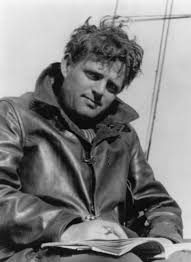
H.L. Mencken
Baltimore Evening Sun/August 25, 1924
I.
Having now devoted a solid month to examining the high and low words of the partisans of the Hon. John W. Davis, of Wall Street, West Virginia, I can only report that I have yet to encounter any sound reason for voting for him. The more these partisans argue that he is a true Progressive, and hot for all the sure cures now on tap, the more they prove that the Hon. Mr. La Follette is even truer and even hotter. And the more they try to make it appear that he is, notwithstanding, a safe and sane man, and one to be trusted fully by every citizen with money in the bank, the more they make it plain that the Hon. Mr. Coolidge is even safer and saner, and still more to be trusted.
In a word, the hon. gentleman falls between two stools. He is, in a very real sense, not in the fight at all; he is simply a sort of bystander—far from innocent, perhaps, but still not actively engaged. The actual combatants are the Hon. Mr. La Follette and the Hon. Mr. Coolidge. Each of these great statesmen stands for something that is simple and obvious—something that anyone may understand. Dr. Coolidge is for the Haves and Dr. La Follette is for the Have Nots. But whom is Dr. Davis for? I’m sure I don’t know, and neither does anyone else. I have read all his state papers with dreadful diligence, and yet all I can gather from them is that he is for himself.
A sense of this fact seems to be going through the country. The Davis campaign is at a standstill. La Follette is belaboring Coolidge, and the friends of Coolidge are belaboring La Follette, but no one seems to think it worthwhile to belabor Davis. He is simply concealed in the crowd, like a bootlegger at a wedding. The sore men, in so far as they have any intelligence at all, seem to be unanimously in favor of La Follette, and the Babbitts, with sound instinct, are all hot for Coolidge. But who is hot for Davis? Not even the political morons south of the Potomac. They will probably vote for him, as they would vote for the devil or even the Pope on a Democratic ticket, but they are no more hot for him than a Federal Judge is hot for the Constitution.
II.
In all this there is a great deal more than mere accident. What ails the hon. gentleman, primarily, is simply the fact that he lacks all the qualities of leadership—that he is fundamentally not a leader at all, but only a follower. His career, as it is described by his friends, is quite devoid of anything plausibly describable as intellectual enterprise. There is no record that he has ever taken the lead in anything, either as statesman or as politician. He was so little original and rambunctious as a Congressman that the attention of the late Woodrow, who hated all men of forceful personality, was attracted to him, and he was made Solicitor-General. He was so careful and undistinguished as Solicitor-General that he was promoted to the Court of St. James. He was so easy a mark at the Court of St. James that the English gave three cheers when they heard that he had been nominated for the Presidency.
What share has the hon. gentleman had in the great political controversies of the past ten years—the most troubled era since the Civil War? Absolutely none. What has he had to say about Prohibition? Nothing save a few disingenuous platitudes. What about the League issue? Nothing but vague nonsense, by the Creel Press Bureau out of Crews House. What about the Ku Klux? Not a word. What about the growth of paternalism in government, the idiotic multiplications of laws, the intolerable increase of jobholders? Several years ago, when he was President of the American Bar Association, he delivered a feeble harangue upon the subject—a harangue reading much like a warmed-over Evening Sunpaper editorial of six or eight months before. Since becoming candidate he has evaded the matter. No one knows clearly what he thinks about it.
His presidency at the American Bar Association coincided exactly with a revolt against the wholesale invasions of the Bill of Rights that were begun under Wilson and continued under Harding. Lawyers in all parts of the country took part in this revolt—men as diverse as Senator Thomas J. Walsh and Dean Roscoe Pound of Harvard, Clarence Darrow and Feather Duster Hughes. But Dr. Davis took no part in it. To this day he has uttered no word about it. Is he in favor of shoving men into jail without jury trials, or is he against it? No one knows.
III.
The learned gentleman’s complete failure as a public man, indeed, has forced his partisans to fall back upon his eminence as a lawyer. But what is this eminence worth—that is, in a candidate for the presidency? It seems to me that it is worth precisely nothing. A man might be the most successful lawyer in the United States, and yet be quite unfit for the office of county sheriff, congressman, or even federal judge. There is nothing in the daily life of a trial lawyer that prepares a man to execute the laws; his experience only increases his competence to evade and make a mock of them. He is engaged professionally, day in and day out, in defending persons who have done so. Dr. Davis has been so engaged for years.
Now he says that he is proud of his career. Why not? His clients, in the main, have been very well heeled, and they have made him rich. I have nothing to say against his satisfaction. It seems to me that it is quite honorable to desire to be rich. It is also quite honorable, at all events in America, to want to be a successful lawyer, an adroit jail-robber. All I contend is that these aspirations are incompatible with the yearning to be President of the United States. The two things simply do not hang together. It is as if I, who have devoted my whole life to advocating Darwinism and other such heresies, should suddenly print a card announcing my candidacy for a bishopric, or, to make the analogy closer, for the stool of St. Peter. The majority of the faithful, I believe, would resent my candidacy, and with sound reason. In the same way a great many Americans resent the candidacy of the Hon. Mr. Davis.
Perhaps the fact explains, in part, the palpable flaccidity of his campaign. But there is a better explanation, I believe, in his lack of all the qualities of genuine leadership—his apparent incapacity to get ahead of ideas and pull them along with him. He is a highly respectable man, but he is nothing else.
IV.
Even Dr. Coolidge, for all his puerility, has this capacity. In his whole life he has probably never thought an original thought, but he has at least shown a talent for dramatizing the thoughts of others. In the present campaign he has very neatly seized the leadership of the Babbitts. Every idea that is honorable and of good report in Pullman smoke-rooms, on the verandas of golf clubs, among university presidents, at luncheons of the Kiwanis Club and where sweaters and usurers meet—all this rubbish he has welded into a system of politics, nay, of statecraft, of jurisprudence, of epistemology, almost of theology, and made himself the prophet of it. He has shoved himself an inch ahead of his lieges. He is one degree hotter for the existing order than they are themselves.
On the other rampart stands Dr. La Follette, obviously a genuine leader, even to the eye of his bitterest enemies. No one has ever accused La Follette of following anyone. He has always been in the forefront of the fray, alike when the going was good, as in Wisconsin when he mowed down the Babbitts, and in Washington during the war, when his foes tried to dispose of him. American fashion, by hitting him below the belt. La Follette is so gaudily the leader that he is followed by thousands who are hot against him. The sheer force of his personality drags along the whole pack of visionaries. His own cellar contains relatively few jugs of peruna, but he is so thrilling that his guests willingly bring their own.
If all these guests could agree upon one brand La Follette would carry twenty-five states, including Illinois and New York. But they simply can’t. For Progressives are like Christians in this: that they hate one another far more than they hate the heathen. The devil doesn’t have to fight the Catholics; he leaves the business to the Ku Klux, i.e., to the Methodists and Baptists. Just so the Progressives devour one another, to the delight and edification of the Babbitts. Some of them, resisting even La Follette’s vast magnetism, have already turned upon him. Others have begun to row among themselves. I believe that by the Tuesday following the first Monday in November the whole pack will be in chaos, and dog will be eating dog. Cal, as I argued several weeks ago, will get the labor vote, old Sam Gompers to the contrary notwithstanding. And he will also get many other votes now credited to La Follette. My guess is that he will be elected to the woolsack of Washington and Lincoln by an immense majority.
 The Archive