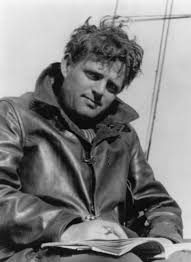
Dorothy Thompson
Spokesman-Review/September 22, 1939
That Colonel Lindbergh should passionately wish to keep this country out of war is not surprising, but his speech in the debate over the arms embargo is. It is surprising and disquieting. The arguments he advances are not those of Senator Borah or Senator Vandenberg. They are much more subtle. For what Colonel Lindbergh clearly implied in his talk last Friday was that unless this country is prepared to go into war with the full force of all its manpower and resources, the Nazis will win it, and that being the case, it is better not to offend them in any way. Sentiment, pity or personal sympathies ought not, he said, to influence our cold judgment of realities. “We must be as impersonal as a surgeon’s knife.”
Colonel Lindbergh’s whole argument deserves the most searching analysis, and there is not space in this particular column to consider it in detail. We shall do that later. But this column would like to take up just one challenge in Colonel Lindbergh’s speech and accept the invitation to one inquiry.
That is his warning to inquire about the personal interests of every speaker. “We must learn to look behind every article we read and every speech we hear. We must not only inquire about the writer and speaker—about his personal interests and his nationality—but we must ask who owns and influences the newspaper, the news picture and the radio station.”
Since the colonel thus raises the question, it seems pertinent to inquire into the personal predilections of Colonel Lindbergh himself. For Colonel Lindbergh, who counsels complete withdrawal from the affairs of Europe, has not himself practiced such withdrawal. From September, 1935, until April, 1939, except for a brief Christmas visit home in 1937, Colonel Lindbergh lived in Europe, and during that time he played a considerable role in European political affairs and exercised a certain influence over European policies.
It is, therefore—and since he recommends such inquiry—important to ask what his viewpoint and influence were.
When Colonel Lindbergh left this country in 1935 he did not believe that the United States or its institutions were the hope of the world.
He had performed a daring and, up to that time, unique exploit designed for and inevitably attended by vast publicity, which made him a center of the news. He felt himself persecuted by the press and developed a hatred and suspicion of the press which became an obsession and which is reflected in his Friday speech.
He had been the victim of a tragic and outrageous crime committed against his child by an alien illegally in this country. In this tragedy all America wept for him and for his wife with those sentiments of pity and personal sympathy which are characteristic of all human beings so long as they retain their humanity.
But when Colonel Lindbergh left this country and went to England he was so full of contempt for American institutions that he discussed with his English friends the possibility of relinquishing his American citizenship and becoming a British subject. In this he was discouraged by his English friends, who felt that Americans would regard the change of citizenship as an affront, and told him that this natural resentment would not be welcomed by England.
While abroad Colonel Lindbergh traveled extensively on the continent, studying the air services of the various powers. In July, 1936, he received a medal from the Aero club of Nazi Germany, presented at a meeting where he first met General Goering.
At the time the Nazi press paid him warm tribute, and in September, 1937, the same inspired press touted him as a potential President of the United States.
In October, 1937, he attended the Munich air conference, went from there to Berlin, and returned to England. He was back in the United States for Christmas in 1937, returning to England in March, 1933.
In April, 1938, still pursuing his intention to remain abroad, he bought the French island of Illiec. The arrangements for this purchase were made by Colonel Lindbergh’s most intimate friend, Dr. Alexis Carrel, the Franco-American scientist. Dr. Carrel is a distinguished scientist. He also was considered the official philosopher of the French Fascist party, led by Doriot, until the dissolution of that party by the outbreak of the war.
In May, 1938, occurred the luncheon at the home of Lady Astor, at which Colonel Lindbergh expressed his high opinion of the German air force and of Nazi organization in general, making reports which were welcome to the group working for “appeasement” with Germany—the group which was then dominant in the British cabinet.
He also deprecated the Russian air force, and his remarks were encouraging to those who were denouncing any collaboration between the western powers and the Soviet Union.
In August, 1938, the colonel made his tour of Warsaw, Moscow, Kiev, Prague and Paris. In October of the same year he left Paris for Berlin and made a tour of Germany, including the airplane factories, where he was reported to have been given every access to information.
On October 19, 1938, he was given the second highest German decoration, the service cross of the order of the German eagle with star. It was presented by General Goering, who hung it about his neck “in the name of the Fuehrer.”
In November of the same year he was the subject of an attack in Everybody’s Magazine, published in London, which recommended that in the interests of everybody Colonel Lindbergh should return to the United States.
During the same month it was announced that he intended to rent an apartment in Berlin and settle down there to study aeronautics.
The report of his intention came only a few weeks after the whole world had been shocked by the cynical breaking of the Munich pact by Germany and coincided with the outbreak of the most ruthless and heartless pogrom which the western world has seen in centuries.
Men, women and little children were routed out of their homes, thousands of men were thrown into concentration camps, a blanket fine of more than half a billion marks was imposed upon a whole community, Jewish businesses were looted, synagogues were set on fire, thousands of German citizens risked their lives in the Nazi reich to give aid to the wretched victims of an organized atrocity, hundreds sent letters abroad to plead that the action was not favored by the German people, and protests arose all over the civilized world.
In this country men of all parties and creeds—the President, Mr. Hoover, Mr. Dewey—protested. But Colonel Lindbergh did not protest.
Apartments and villas were then available in Berlin because so many had been forcibly evacuated. But the colonel’s idea of settling in Germany provoked much adverse comment, and he abandoned the idea of a German residence and removed to an apartment in Paris.
On January 7, 1939, he reported to the United States on German aviation. He sailed for this country last April. His Friday speech is his first public utterance on American political affairs.
Colonel Lindbergh’s inclination toward Fascism is well known to his friends. “Pity, sentiment and personal sympathy” play little role in his life. On the other hand, he has a passion for mechanics and a tendency to judge the world and society purely from a technical and mechanical standpoint. The humanities, which are at the very center and core of the democratic idea, do not interest him, and he is completely indifferent to political philosophy.
A man who has never spared himself physically, but has taken upon himself the most grueling training, keeping himself awake and without food for days, he has the utmost contempt for physical weakness. Cruelty does not affront him. He is himself a cruel practical joker.
He also is a national hero, and because this country loves its heroes, the press, which Colonel Lindbergh hates, has behaved very chivalrously toward Colonel Lindbergh’s ideas.
But since he himself has warned that all who speak in the present situation should have their personal interests inquired into, he cannot object to an inquiry into his own biases. And his are not the predilections of the majority of Americans or of democracies anywhere.
 The Archive