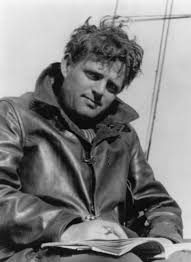
Dorothy Thompson
Fort Worth Star-Telegram/September 24, 1939
A curious thing is happening in the debate over the arms embargo. Those who believe that we should lift the embargo on arms are being branded as “propagandists,” despite the fact that most of them were opposed to this concept of neutrality long before any war of general European dimensions was in sight. Those who want us to keep the embargo are representing themselves as the true upholders of American interests against foreign war mongers.
In this debate there are two points of view regarding the attitude that the United States should take at this movement toward the war. The one is most clearly embodied in the letter which the former Secretary of State Mr. Stimson addressed to the public through the “New York Times.” The other has been most completely pleaded for in the address of Colonel Lindbergh.
The first viewpoint is that the United States should return to the traditional procedure of international law, sell arms to friendly powers who have money to pay for them, strengthen our defense and be prepared to defend American interests at whatever point they are menaced. At this juncture we should make no hard and fast program, but do everything possible to maintain our position as a world power and as the world’s greatest society of free people.
The second viewpoint is that the struggle elsewhere in the world in no way concerns us as a world power or as a democratic society, and that we should maintain our attitude of complete aloofness, keeping and even perhaps extending the embargo.
The American people ought clearly to realize that the proponents of both concepts of neutrality are making propaganda, since the expression of any viewpoint is propaganda. We will take one course or the other, for we can only take one course or the other. The proponents of neither policy wish us to send an army to France. On both sides there are honest men and women, and their decision will be determined by their viewpoint on the issues, their analyses of the nature of the war and the possible effects of its outcome on the United States, and by their own personal biases.
The Western Powers certainly hope that we will take the first course, and therefore all of us who advocate the first course are supporting a policy welcome to the Western Powers.
The National Socialist Government of Germany is concentrating its entire propaganda machine on pressing us to take the second course. Therefore all who advocate it are advising a course welcome to Germany and her associates.
Whatever the motives, whatever the prejudices and whatever the intellectual convictions, Mr. Stimson is a propagandist for the Western Powers by reason of his stand, and Colonel Lindbergh is no less a propagandist for Germany by reason of his stand. Whatever course we take will aid one side and harm the other. That itself is a comment on the lack of reality of our isolation.
If we refuse in defiance of international practice to sell arms to powers, one of which has a great dominion on the North American continent, with three thousand miles of unfortified frontier on our own country, with both of which we have been at peace for more than a hundred years, and neither of which for more than a hundred years has ever sought to influence or change our domestic institutions, we shall definitely be aiding Nazi Germany and her benevolent assistant Bolshevik Russia, whose philosophies of life and government do openly challenge our institutions.
There is no way in which we can avoid making a decision favorable to one side or the other. If we maintain an embargo in a distortion of traditional neutrality England and France have at least as much reason to regard it as an unfriendly act as Germany would have if we lifted it.
Leaving sentiment, pity and personal sympathies out of account, and being as “ruthless as a surgeon’s knife,” this is the fact.
And it seems to me that it is pertinent to point out that with all this talk about propaganda the only widespread propaganda in this country directly connected with and traceable to foreign powers and accompanied by large-scale organization of American citizens are the Nazi and the Communist.
Communist party leaders have testified before the Dies committee that they have 200,000 members in this country, and that they are spending on an average of $2,000,000 a year. They have their own publications. The Communist party is an authoritarian organization; it follows slavishly the line laid down in the Kremlin, and it is concentrating its whole propaganda activities now in denouncing Great Britain as a war monger and pinning the blame for the war upon Great Britain. By a feat of unexampled disingenuousness it still maintains that the Russian offer of benevolent aid to Germany, which, with it in his pocket Hitler marched against Poland in full realization that he was starting a general war was an act of peace.
There is a Nazi organization in the United States. It has many thousands of members and its own press. It, too, has performed a marvelous feat of volte face since the Russian-German pact. According to the “Deutscher Weckruf und Beobachter,” Russia has become national bolshevist, and “bolshevist” means majority rule. Through meetings and through its press the Bund and its fellow-travelers are attempting to make a solid bloc of German-Americans and are organizing a letter campaign upon Congress.
Wednesday’s issue of the “Deutscher Weckruf” played up the Lindbergh speech in a headline across the entire front page. “We shall be deluged with propaganda.” The im- plication is that the “Deutscher Weckruf” is not making propaganda. But long before this war began this paper was a pure and simple Nazi sheet, heartily supporting and no doubt part of Fritz Kuhn’s organization in the United States.
Nobody who reads the Nazi propaganda here can possibly believe that its readers have American interests at heart—except as they see those interests completely merged with those of Germany. This is not the standpoint of most German-Americans, but the war makes it possible to graft Nazi ideology upon the firm American will to keep our boys out of Europe.
This needs to be realized when we hear passionate pleas for “America first” from people and organizations whose allegiance is elsewhere.
This war is being fought in a very peculiar way. It is in the first line a war of ideas. In this war of ideas no neutrality is respected. On the other hand, neutrality itself and the various interpretations of neutrality are part of the strategy of the war.
At this time when the Nazis in the United States are insisting that to repeal the embargo on arms and to return to traditional international law would amount to an act of war against Germany, they interpret the Russian action as “neutrality.” And the German concept of neutrality as applied, for instance, to Rumania and to Italy, is of a neutrality wholly benevolent to Germany—whereby Germany profits more by their neutrality than by the actual participation of these countries in the war.
The campaign of those who wish this country to aid Germany consists entirely in presenting the war as a purely internal European struggle—in spite of the fact that it is already being waged on every continent of the world, except South America, where it is still in the “cold” stage.
It also consists in attributing the entire cause of the war to the Treaty of Versailles—which again is Colonel Lindbergh’s view—and this despite the fact that the Treaty of Versailles was as extinct as the dodo before this war began.
Every effort is made to minimize the revolutionary character of Nazism and to present Russia as a purged nation and a no longer menacing world ideology—despite the fact that Premier Molotov on the day that the Russians marched into Poland hailed the triumphal procession of the world revolution.
To lift the embargo on arms by no means indicates that this nation is going to plunge into the war. This column, which advocates the lifting of the embargo and has done so for two years, strongly hopes at the same time that we reserve all further action most carefully while strengthening our defenses and watching the day to day developments. They may be very different from anything at present anticipated. Under no conditions should we commit ourselves as yet.
But we would do very well to take a look at some of the things that are going on within our own borders.
For the worst possible place to have this war fought out would be on our own soil. There are minor riots going on in this country at this minute.
And it would be well for some of those who quote Washington’s Farewell Address to read all of it and to recall the conditions under which it was delivered. It was pre-eminently a denunciation of foreign revolutionaries seeking to divide this country. It is more pertinent today than at any time since it was uttered.
 The Archive