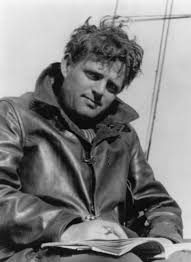
Stephen Crane
New York Tribune/August 14, 1892
“Founder” Bradley’s Cosmopolitan Domain
Asbury Park, N.J., Aug. 13.—During the summer months the famous boardwalk at this resort takes a sudden leap into a prominence quite equal, it would seem, to that of any street, boulevard or plaza on the earth. Apparently the centre of the world of people, not of science nor art, is situated somewhere under the long line of electric lights which dangles over the great cosmopolitan thoroughfare. It is the world of the middle classes; add but princes and gamblers and it would be what the world calls the world.
In the evening it is a glare of light and a swirl of gayly attired women and well-dressed men. There is a terrific tooting by brass bands and a sort of roar of conversation that swells up continually from the throng. There are no clusters of “fakirs” adding their shrill cries to the clamor, nor none of the many noisy devices to catch the unwatched nickel. Only the crowds, the bands and the surf.
Occasionally philosophers ponder over the question why all these people come down to the beach evening after evening There is the sea; but it is evident, at first glance, that no one ever looks at the sea or considers it in any way. The crowd at Asbury Park does not sit and gape at the sea. The Atlantic Ocean is a matter of very small consequence. No doubt occasional glances are thrown at it. Lovers on the beach are supposed sometimes to contemplate it, when the moon peeps over the horizon, but it is apparent that the ocean is a secondary matter and is merely tolerated. It could not be the music, of course, because thousands of people would not congregate to hear indifferent bands play.
But the people come to see the people. The huge wooden hotels empty themselves directly after dinner; the boarding houses seem to turn upside down and shake out every boarder; the cottagers make ready for an evening stroll, and up in the business part of the town the merchants and clerks bestir themselves and finish their work, roll down their sleeves and put on their coats. Then all hie to the big boardwalk. For there is joy to the heart in a crowd. One is in life and of life then. Nothing escapes; the world is going on and one is there to perceive it.
The walk itself is a heavy plank structure varying from 50 to 100 feet in width, and extending along the entire ocean frontage of the town. It is built on heavy pilings whose tops are usually from four to ten feet above the beach. Rose of immovable wooden benches stretch along the edge of the walk, and landward a lawn comes flush with it. Next to this is a brick walk and then the driveway, Ocean Ave. Statues, allegorical and memorial, occupy positions on the lawn, with also many little pavilions and summer houses. During certain hours this great passage is fairly choked with humanity. The whole space—one mile long by 50 to 100 feet wide—is alive and swarming with pedestrians. Confusion never reigns only because the general pace is leisurely and everyone “keeps moving.”
Day excursion trains sometimes bring down as many as 15,000 people to enjoy a few cool hours by the sea. This momentarily gives the resort a population of about 45,000, And they all appear on the beach. When great public meetings are held on the beach and boardwalk, audiences of 10,000 persons gather frequently. It is said that 20,000 people watched the participants in the annual baby parade as the nurse maids trundle their charges down the walk.
The average summer guest here is a rather portly man, with a good watch chain and a business suit of clothes, a wife and about three children. He stands in his two shoes with American self-reliance and, playing casually with his watch-chain, looks at the world with a clear eye. He submits to the arrogant prices of some of the hotel proprietors with a calm indifference; he will pay fancy prices for things with a great unconcern. However, deliberately and baldly attempt to beat him out of fifteen cents and he will put his hands in his pockets, spread his legs apart and wrangle, in a loud voice, until sundown. All day he lies in the sand or sits on a bench, reading papers and smoking cigars, while his blessed babies are dabbling around throwing sand down his back and emptying their little pails of sea-water in his boots. In the evening he puts on his best and takes his wife and the “girls” down to the boardwalk. He enjoys himself in a very mild way and dribbles out a lot of money under the impression that he is proceeding cheaply.
However, the long-famous “summer girl” takes precedence in point of interest. She has been enshrined in sentimental rhyme and satirical prose for so long that it is difficult for one to tell just what she is and what she isn’t. If one is to believe the satirists, a man would better encase himself in a barrel, put dinner plates down his trousers’ legs and shake hands with her by means of a very long-handled pitchfork. If the rhymers are to be relied on, she is a maiden with a bonny blue eye and a tender smile and with a red heart palpitating under fields of white flannel. At any rate, she is here on the boardwalk in overwhelming force and the golden youths evidently believe the poets.
The amount of summer girl and golden youth business that goes on around the boardwalk is amazing. A young man comes here, mayap, from a distant city. Everything is new to him and in consequence, he is a new young man. He is not the same steady and, perhaps, sensible lad who bended all winter over the ledger in the city office. There is a little more rose-tint and gilt-edge to him. He finds here on the beach, as he saunters forth in his somewhat false hues, a summer girl who just suits him. She exactly fits his new environment. When he returns to the ledger he lays down his coat of strange colors and visions fade. Allah il Allah.
Great storms create havoc with the heavy planking of the walk nearly every fall. The huge beams are torn and twisted and smashed by the breakers in a regardless manner, making an annual bill of expense of $15,000. This bill for repairs is met by James A. Bradley. He is a millionaire, who bought the land upon which this resort is situated years ago for a nominal price. He still has great possessions here. A part of them is the ocean front. Everybody knows him and everybody calls him “Founder Bradley.” He is a familiar figure at any hour of the day. He wears a white sun-umbrella with a green lining and has very fierce and passionate whiskers, whose rigidity is relieved by an occasional twinkle in his bright Irish eye. He walks habitually with bended back and thoughtful brow, continually in the depths of some great questions of finance, involving, mayhap, a change in the lumber market or the price of nails. He is noted for his wealth, his whiskers, and his eccentricities. He is a great seeker after the curious. When he perceives it he buys it. Then he takes it down to the beach and puts it on the boardwalk with a little sign over it, informing the traveler of its history, its value and its virtues.
On the boardwalk now are some old boats, an ancient ship’s bell, a hand fire engine of antique design, an iron anchor, a marble bathtub and various articles of interest to everybody. It is his boardwalk, and if he wants to put 7,000 fire engines and bathtubs on it he will do so. It is his privilege. No man should object to everybody doing as he pleases with his own fire engines and bathtubs.
“Founder” Bradley has lots of sport with his ocean front and boardwalk. It amuses him and he likes it. It warms his heart to see the thousands of people tramping over his boards, helter-skeltering in his sand and diving into that ocean of the Lord’s which is adjacent to the beach of James A. Bradley. He likes to edit signs and have them tacked up around. There is probably no man in the world that can beat “Founder” Bradley in writing signs. His work has an air of philosophic thought about it which is very taking to any one of a literary turn of mind. He usually starts off with an abstract truth, an axiom, not foreign nor irrelevant, but bearing somewhat upon a hidden meaning in this sign—“Keep off the grass,” or something of the sort. Occasionally he waxes sarcastic; at other times, historical. He may devote four lines to telling the public what happened in 1869 and draw from that a one-line lesson as to what they may not do at that moment. He has made sign=painting a fine art, and he is a master. His work, sprinkled broadcast over the boardwalk, delights the critics and incidentally warns the unwary. Strangers need no guide-book nor policeman. They have signs confronting them at all points, under their feet, over their heads, and before their noses “Thou shalt not” do this, nor that, nor the other.
He also shows genius of an advanced type and the qualities of authorship in his work. He is no mere bungler nor trivial paint-slinger. He has those powers of condensation which are so much admired at this day. For instance: “Modesty of apparel is as becoming to a lady in a bathing suit as to a lady dressed in silks and satins.” There are some very sweet thoughts in that declaration. It is really a beautiful expression of sentiment. It is modest and delicate. Its author merely insinuates. There is nothing to shake vibratory senses in such gentle phraseology. Supposing he had said: “Don’t go in the water attired merely in a tranquil smile,” or, “Do not appear on the beach when only enwrapped in reverie.” A thoughtless man might have been guilty of some such unnecessary uncouthness. But to “Founder” Bradley it would be impossible. He is not merely a man. He is an artist.
 The Archive