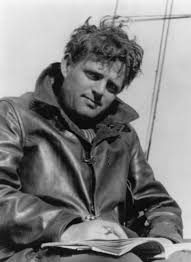
H.L. Mencken
San Francisco Bulletin/December 27, 1926
(This is one of a weekly series of impressions by H. L. Mencken, editor of the American Mercury. Mencken is perhaps the foremost writer in the United States today. His followers are legion. His writings will appear every Monday in The Bulletin.)
What the astute psychologist chiefly notices, reading the great masterpieces of literature, foreign and domestic, is the frequency with which their authors descend to the obvious and the banal. It is like contemplating a rose garden cluttered with Jimpson weeds, or drinking champagne mixed with sarsaparilla. I bar none; even the inspired authors of the sacred books knew how to be silly; the fact is what holds millions of their customers today. When one turns to merely human writers the thing becomes downright painful. In the midst of Nietzsche’s most penetrating passages there are thoughts apparently borrowed from Arthur Brisbane, at the time a boy of four or five. Goethe, plunging down from his Olympian heights, only too often wallowed obscenely in platitude. And Shakespeare, as everyone knows, had such a weakness for drivel that his most earnest rooters today are college teachers of English.
Among the writers of our own time that dismaying oscillation between the sublime and the maudlin is ever noticeable. The same Dreiser who wrote the magnificent last scene in “Jennie Gerhardt” and the superb character sketches in “Twelve Men” also wrote “The Color of a Great City” and the worst chapters of “An American Tragedy.” Joseph Conrad and Ford Madox Hueffer, the first a man of the first genius and the second a very talented and amusing fellow, combined to write “The Inheritors,” a book so bad that no self-respecting human being is known ever to have read it. The Willa Cather of “My Antonia” also wrote the last chapter of “One of Ours”—and is apparently proud of them. The H. G. Wells of “The World of William Clisseld” also wrote “The Wife of Sir Isaac Harman.” The Kipling of “Barrack Room Ballads” also wrote hymns of hate against the accursed Hun. The Edgar Lee Masters of “The Spoon River Anthology” also wrote “Mirage.” But I spare you any more such rattling of glass eyes and wooden legs.
The point is that even the noblest specimens of Homo sapiens, when engaged in the agonizing act of thinking, occasionally slip comfortably into the easy imbecilities of a suburban pastor, a congressman, or a lieutenant of cavalry or police. There seems to be something intolerable about continued meditation upon the highest levels. As Nietzsche himself once said, the air is very cold up there and it is unpleasantly lonely.
The most diligent philosopher, his soul frostbitten, comes down now and then for a holiday. It is to this fact that we owe the Book of Revelation, Schopenhauer’s essays on women, Walt Whitman’s critical prose, “Cymbeline,” Poe’s monograph on handwriting, and the popularity of Ralph Waldo Emerson among New Thoughters.
Qualities of Greatness Still New to Man
But why should the great be so tender? Why is it always so impossible for them to make and hold the grade? The answer, I believe, is to be found in the fact that all the qualities which distinguish them from the rest of us—all the peculiar merits and capacities which set them above the general average of the human race—are relatively recent acquisitions of that race, and still very shy and strange.
The first philosopher, in the modern sense, was born at Miletus, in Asia Minor, so lately as January 17, B.C. 542. Even the first chiropractor did not begin to meditate upon the backbone until a scant thousand years before. This philosophy is but 80 generations old, and chiropractic is but 33 more. If alcoholism were so young in the world, even prohibition agents would be floored today by a few rounds of malt liquor. If government were so young, even congressmen would still have consciences.
All this is commonly forgotten when the processes of the human mind come under survey. The psychologists who devote themselves to the subject are dismayed and fevered by what they discover. They find that the most austere and reflective of men, habitually devoted to logic in its highest forms, begins to heave and blubber like a stock company actor when the band begins to play, or Dr. Coolidge makes an idealistic speech, or Queen Marie throws him a kiss, or he overhears his wife telephoning to her handsome doctor. They conclude thereupon that the whole human race is half idiotic and that progress is a chimera.
It seems to be that they are unduly depressed. The truth is that the human race, in a few thousand years, has gone ahead amazingly and especially in the department of intellect. Its material progress, in fact, is vastly less impressive than its psychic progress. It has thrown off nine-tenths of the delusions that held it in thrall at the time it emerged into history and it is throwing off the rest at a rate that constantly increases.
Burden of Knowledge Becomes Too Much
What even the most intelligent man believed a thousand years ago—about God, about the natural forces surrounding him, about his own body, about the character and quality of truth—is now laughed at by every bright schoolboy and even by many schoolteachers. There is a vast stock of exact knowledge in the world today and it is receiving additions every hour.
All this knowledge, to be of any use to an individual, must be packed into the cells of a single brain. Just how it is stowed there we do not know, but that the brain houses it is manifest to everyone. The trouble is that the cortex, which bears the chief burden, has not developed with sufficient rapidity to take care of the increasing stock. It was sufficient in the days of the Greeks and so they did a great deal of excellent thinking, but it is not sufficient today and so the business of thinking grows difficult and even the most superior men have to take holidays from it.
To accommodate the new mental baggage of the race the cortex should have doubled in size by the year 200 B.C. But if it has grown at all, it certainly is not more than 5 per cent. Thus it tends to run hot when it is worked and its running hot has to be relieved by plunging the cool swamp of the platitude. No literate man of today is quite as ignorant and credulous as Plato was. But no man of today can think as steadily and furiously as Plato thought, without risk of setting his hair afire.
Only a small minority of men, indeed, may venture to indulge in such thinking at all, even as a transient dissipation. When the average man essays to do so, his brain begins to smoke almost instantly and thereafter he must either stop thinking altogether or resign himself to lunacy. The cause thereof is as I have stated: the body of modern knowledge has got beyond the capacity of the normal cortex. Turn, for example, to the field of religion. So long as the whole corpus of knowledge in that department was to be found within the covers of the Bible, it could be grasped by the ordinary man.
Reason for Church Quarrels in World
But when the exact sciences began to pour in additions and modifications—for example, in the form of hypotheses of organic evolution—and when psychology began to complicate the matter by analyzing the primary religious impulse and the nature of thought itself—when these new complexities and confusions got into the business it passed beyond the reach of the general.
It is for this reason, I believe, that religious controversy and ill feeling now rage in the world, and especially in the United States, where an unwise effort has been made to burden all men with the knowledge that can find room only in the cortexes of a lonesome few.
The fundamentalists of this great land are in their lather, not because they have weighed the Bible against Darwinism and decided calmly in favor of the former, but because they have tried to understand Darwinism and found it impossible. Their cortexes are simply unequal to the strain and one finds constant proofs of the fact in their discussions of the subject. What fevers them is not the fear that their opponents will go to hell, but the pain in their own heads. They are in the exact position of frogs trying to swallow haystacks.
The remedy lies in protecting them against such assaults. That remedy is being applied in Tennessee and Mississippi, and it will be applied more generally, I believe, later on and in wider circles. The body of modern knowledge grows so large and complicated that every attempt to utilize it in thought begins to constitute a menace to the peace and sanity of the human race.
Even the best of men, exploring the higher reaches of what is now known, have to drop back into platitude occasionally to preserve their normalcy. The rest of us run grave risks. Every time we roll our eyes upward to the stars, we monkey, so to speak, with a buzzsaw.
 The Archive