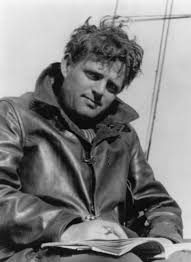
Damon Runyon
Lancaster New Era/May 10, 1930
BALTIMORE, May 10.—“Here comes Sande! Here comes Sande!”
Across the green vale of Maryland, in which rests old Pimlico race track, the cry rose from 40,000 throats yesterday afternoon. Out of a winding reel of bright color, far up the sunlit track, a white jacket splashed with red spots like blood was not to be mistaken.
“Here comes Sande! Here comes Sande!”
The cry was like an echo, so often has it rolled across the Maryland landscape.
Two hundred feet from the wire and “Doc” Cassidy’s Crack Brigade in front with George Ellis pounding his polished sides, when here came Sande, master horseman of his time, with a real race horse under him in Gallant Fox.
Sande “Lifts” Him Over
The shrewd hands of the great Sande seemed to lift his mount over those last few yards of ground. Now the red-hooded head Gallant Fox was in front and moving on and as the pair raced under the wire, the Fox had three-quarters of a length the best of it and the East had a real hope for the Kentucky Derby. From the turn into the stretch the pair had raced almost head and head for the $50,000 stake and not until the last couple of jumps was Crack Brigade defeated.
Six lengths behind the front runners was Snowflake, a filly owned by Walter J. Salmon, who has twice won the Preakness.
The time of the race was 2:00 3-5, which is slow for the Preakness distance, but it didn’t seem slow to the mob watching the ding-dong struggle.
Gallant Fox had a lot of bad luck and Sande had to take him away to the outside of the field at the first turn to get a decent running position.
Tetrarchal, of the Howe stable, which also had Gold Book in the race, got off in front and led the way clear around to the back side with Crack Brigade in close attendance on him.
Sweet Sentiment Weakens
Sweet Sentiment, from the Seagram Stable of Canada, lay third the first time past the stand, but Sande moved Gallant Fox in that hole on the first turn. He closed a terrific amount of ground to get there, coming from almost last.
Then Earl just rated his horse along with Crack Brigade, letting Tetrarchal do the running. This nag died away before the turn into the stretch, when the battle narrowed down to Crack Brigade and Gallant Fox.
The best horse won, but the finish would have delighted our noble visitor, the Earl of Derby, who bred Light Brigade, daddy of “Doc” Cassidy’s horse.
William Woodward, president of the Harriman National Bank of New York and owner of Gallant Fox, saw his horse win and afterwards went into the stand to get his trophy. Only recently Gallant Fox won the Wood Memorial Stakes in New York and is now favorite for the Kentucky Derby next week.
The cheers yesterday were for Sande. Never a more popular jockey straddled a horse. He stood in the weighing-in stand after the race bareheaded and grinning and the crowd yelled again and again. The great rider retired about a year ago on account of increasing weight and raced his own stable, but, finding that unprofitable, he came back this season to ride one of the best horses he ever had under him.
Pays $4 Straight
Gallant Fox paid $4 straight, $4.30 to place and $2.90 to show in the mutuels. A surprising price. Reports that he had sulked in his last workouts probably kept some from betting on him, but he carried a world of money just the same.
The mutuel price is about even money straight and thirty cents above that a place. Behind Snowflake, the third horse, the rest of the field was pretty well strung out. Michigan Boy was fourth and Armageddon, second choice with the bettors, was away back.
This was the fortieth running of the Preakness, which started in 1873. Oddly enough, it was the first time Sande ever rode the winner in this race, though he had won many other big stakes.
Gallant Fox No. 1
Gallant Fox had No. 1 on his saddle blanket and Earl Sande’s shoulders were draped with the red-spotted white jacket of the Belair Stud, one of the oldest breeding farms in Maryland. A scarlet cap was on the head of the one-time king of the ace riders as he went bobbing by in the post parade.
Never a finer looking steed went to the post in the Preakness than the favorite. “Doc” Cassidy’s Crack Brigade was another good looker. The Doctor has a gaudy -light blue jacket and orange sash with orange sleeves and cap.
The pink of the Salmons was about the most familiar colors in the race. L. Schaefer wore them on Swinfield and A. Robertson on Snowflake. There 18 rarely a Preakness that the New York real estate owner doesn’t have a starter.
The Whitneys were missing—Harry Payne and the Greentree. Nothing from the Bradley Barn or the stable of McLean, the Washington publisher. No Wideners either.
Governor Ritchie got a big hand from the crowd and a gush of “My Maryland” from the band as he climbed the steps to the judges’ stand to see the race and present the Woodlawn Vase, the old trophy that goes to the winning owner, who always gives it back. Someday an owner will get everybody very angry by lugging the vase home, but the average owner would be quite contented with the $52,925 that was first money today.
The sun was getting low behind the stand when the bugle brought the horses to post, where Jim Milton, the veteran starter and his assistant awaited them. At that time the proletariat had taken so much of Gallant Fox in the machines the last betting showed him at even money. Armageddon, the Jeffords Man o’ War, kicked up a row on reaching the barrier. He is a bad post actor, and -the other day they had to let the jockey, dismount and walk Eaby, the jockey, dismount and walk the steed around, then remount in the starting stall.
Gallant Fox stood very quietly. So did all the others. The assistant starters wrestled valiantly with Armageddon to get him in the stall. Finally the old familiar cry arose, “They’re off,” the age-old war whoop of the turf, and down the stretch came the rolling ball of color.
Official Washington always makes quite an occasion of Preakness Day. Vice President Curtis, who used to be a jockey long ago, was present with a job lot of Senators and Representatives. Mr. Curtis is a steady customer of the Maryland races, anyway. Governor Ritchie, of Maryland, who hasn’t missed a Preakness in years, was on hand.
Part of the overflow crowd went into the field to sit among the little yellow flowers blooming there. The steady march of Baltimore is gradually squeezing old Pimlico into a little oasis of green and white surrounded by red brick dwellings. The street cars running past the plant seem, from the grandstand, to be traveling the white outer rail of the first turn of the track.
The Preakness was the fifth race of the day and as it came up, as the horse players say, there was a rush for the mutuel machines, under the stand where it was plenty hot, especially for the losers. The mutuels today must have “handled” close to $1,000,000 on the race, through the fields were small and mediocre. The $2 machines got the big play. Scarcely anyone goes to the Preakness without making a bet.
Gallant Fox was sent out at 2 to 1 in the first betting, with the Salmon Stable’s Snowflake and Swinfield at 8; the Howe’s Tetrarchal and Gold Brook at 12 and Doc Cassidy’s Crack Brigade at 5. The two Man o’ Wars in the race, Full Dress and Armageddon, were at 20 and 4, respectively. Michigan Boy was 8 and the Seagram’s Sweet Sentiment was 15. Woodgraft, belonging to the Audley Farm, was 10 to 1.
Gallant Fox came out for a warming up with a stable boy on his back and the crowd went “oo-ah” in admiration. The son of Sir Gallahad, 3d, and Marguerite is a beautiful looking thing—a bright bay in color and powerfully built.
The band played one of the football war songs of Annapolis as the favorite in the big race galloped past—then one about “Sink the Army.” I couldn’t see the connection.
 The Archive