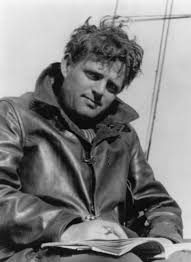
H.L. Mencken
Baltimore Evening Sun/May 3, 1910
We Americans have been warring upon the Indian for three centuries or more, but we have yet to penetrate his secret. What sort of man is he? What is his view of the world? What does he think of us, his conquerors?
We have come to understand the various races of white men well enough, including even the Slav and the Latin, and we have begun of late to get some insight into the mind of the black man, but the Indian is still a mystery. Grim, silent and immovable, he seems destined to remain a fantastic outlander forever. We have fought him; we have beaten him and we have reduced him to practical slavery, but we still search in vain for the soul within him.
This ignorance after all is not hard to explain. It is to be blamed, no doubt, upon the fact that those white men who have known the Indian best have been least able to write about him. The white renegade, living among the braves as one of them, is seldom a scrivener; the missionary, living among them, but not of them, gets the distorted view which always goes with enthusiasm, and the soldier, chasing them, can study them safely only as cadavers.
A Man Who Knows.
The result is an Indian literature which must give the red man himself a good deal of amusement. We have the sentimental rhapsodies of James Fenimore Cooper, who studied the Indian at Otsego Lake just as one might study the secretive Sicilian on Ellis Island; we have the stupendous Munchausen romances of the scouts; we have the dime novels and melodramas of the year before last, and we have, finally, the incredible tracts of the Lake Mohonk platitudinarians. In all that mass of printed paper there are very few plausible pictures of Indians. Sam Houston and his like were ignoramuses, and those self-constituted authorities who have actually seized their pens in hand have been gifted, as a rule, with far more assurance than knowledge.
But now, after many years, there comes a writer who really knows the Indian—at least the Indian of these degenerate times—and who is able to write about him clearly, entertainingly and convincingly. The name of that almost unprecedented man is James McLaughlin, and he has been one of Uncle Sam’s Indian agents for 39 years.
In 1871, when he opened his first office on the Dakota plains, the red man was still a roving savage. During the time since then Mr. McLaughlin has had a hand in practically all of the republic’s dealings with its disappearing charges. He has known all of the big chiefs and medicine men, from Sitting Bull and Spotted Tail to Chief Gall and Rain-In-the-Face. He has been alternately the scourge of the braves and their best friends: he has won their confidence and their respect, and so his book of reminiscences, “My Friend, the Indian,” is a book worth reading, a book revealing sound knowledge and shrewd reflection, a book that stands head and shoulders above the common run of Indian books.
The Real Indian.
As might be expected, Mr. McLaughlin points out many errors in the popular view of the Indian. It is commonly assumed, for example, that the red man’s one most prominent characteristic is his stoicism. He is placed in evidence time and time again as a human being entirely devoid of emotions. It is alleged that he has no fear, no heart, no nerves, no sense of humor. Mr. McLaughlin sweeps that theory into the rubbish heap.
“The stoicism of which so much is heard,” he says, “is no part of the Indian character. What has been described as stoicism, the trait that the Fenimore Coopers and other Indian romancers have been so fond of exploiting, is simply shyness. The Indian, as I have found him (and I have known the people under nearly all possible circumstances) is extremely shy with strangers, and this shyness takes the form of constitutional secretiveness in strenuous moments.
“The Indian child who appears savagely reticent to a stranger is very likely the most joyous romp with people he knows, be they white or red. He is shy as a wild thing is shy. The Indian man who suffers tortures without making a sign is not indifferent to pain, nor especially desirous that he should be regarded as indifferent. He is simply indulging his exaggerated tendency to secretiveness.
“An Indian in a crowd of whites will probably be wild with excitement over the strange things he sees, but he has too much regard for his own dignity to expose his sentiments. Let him understand that he is among friends or free from personal scrutiny and he is as joyously exuberant as though he had never possessed either dignity or secretiveness.
“I think that the most hilarious lot of men I ever saw was a crowd of Sioux, many of whom had been on the warpath against the whites, and all of whom regarded themselves as men of importance among their people—whom I took to see a musical comedy in Washington. They forgot the place, the people and their strange surroundings and whooped for very joy.”
Not Afraid Of Tears.
Mr. McLaughlin, going further, maintains that the Indian, like all other savages, is far more emotional than the civilized white man. Among his own people he is not afraid to weep. He is an ardent and romantic wooer, and when the tender passion overcomes him he lets everyone know it. Suicides for unrequited love are by no means rare among the Indians—even among the warlike Sioux. And the red man is always a sentimental and indulgent father and son. He delights in dandling his young upon his knee, and he delights in paying extravagant reverence to his mamma.
Mr. McLaughlin has a number of extremely interesting chapters upon the Indian wars of the last generation, in most of which he had a hand. He proves, by abundant evidence, that Sitting Bull, whom he knew very well, was far from a valiant warrior or wise chief. As a matter of fact, that unromantic rascal was an arrant coward, who fled in alarm from the battle of the Little Big Horn.
It was his great skill as a medicine man and not his military cunning that made him a man of influence. Sitting Bull, in a word, was a priest rather than a general. A shrewd guesser and an alert student of Indian character, he played upon the superstitions and credulity of his fellows. He was a master of ex post facto prophecy. Whenever a battle was won he found it easy to convince the Sioux that he had predicted a victory; whenever a battle was lost he found it equally easy to recall some lugubrious prognostication of disaster.
In the end it was Mr. McLaughlin that brought about the old scoundrel’s death. Sitting Bull, then a sort of prisoner of war, was quartered upon the Standing Rock agency reservation, of which Mr. McLaughlin was in charge. Toward the end of the eighties he had begun to take a hand in the ghost-dancing agitation, which owed its origin to a crazy Indian named Kicking Bear, and in the fall of 1890 there appeared reason to believe that he was planning an escape to the Bad Lands to join the braves at large and set them upon the warpath.
The End of Sitting Bull.
Mr. McLaughlin visited Sitting Bull and ordered him to leave his farm within a week and come in to the agency headquarters. Sitting Bull promised to do so, but that promise was not kept. Then Mr. McLaughlin sent Lieut. Bull Head, of the Indian police, after him—and what happened belongs to history.
Bull Head took 39 Indian police and four other friendly Indians volunteered to go along. They found Sitting Bull in his house in the midst of the village of admirers that had grown up about it. Bull Head gave him half an hour to array himself in his dress-parade raiment, and he expressed his willingness to come in peace, but when he came out and his followers began to taunt him for surrendering so ingloriously he suddenly shrieked a battle cry—and the fight began.
On the one side were 44 Indians from the agency and on the other side were 160 of Sitting Bull’s adherents, all armed and all frenzied fanatics. At the arrest first Bull Head and First Sergeant Shave Head fell, but from the ground Bull Head sent a bullet through Sitting Bull. An instant later Second Sergeant Red Tomahawk finished the old medicine man with a revolver shot through the head. On the side of the police six men were killed and a score wounded, and on the side of the hostiles twice as many more.
That was the last stand of the belligerent Sioux. Their fighting days were over.
 The Archive